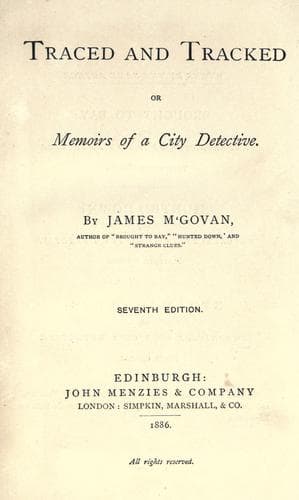
Traced and Tracked; Or, Memoirs of a City DetectiveM'Govan, James
General
Traced and Tracked; Or, Memoirs of a City Detective
M'Govan, James
Detective and mystery stories; Edinburgh (Scotland) -- Fiction
Hanford made the most strenuous attempts to get back the custody of
his boy—who was lame and rather weakly—but failed completely, though
he had money and lawyers to help him. An inquiry had been by that
time despatched to the Cape, to ascertain whether the so-called John
Ferguson had been legally married to Rosa Gladwin, the girl who in
Scotland had passed as his wife. In anticipation of the answer to
that question being against him, Hanford redoubled his exertions to
quicken the slow processes of law which were to give him charge of
his boy; but with almost the same result as if he had single-handed
tried to push on some great Juggernaut. The ponderous thing moved
none the faster, but all the heat and turmoil and excitement fell to
Hanford. He was continually running between his temporary home and
his lawyers, and in one of these races he caught a chill which he
“had not time to attend to.”
When the pain became unbearable, he was forced to lie down and send
for a doctor. By that time he was almost delirious and in a high
fever. The doctor pronounced the trouble inflammation of the lungs,
and the case critical.
The moment Janet Hanford heard of the illness she came to see her
husband, bringing with her the boy, whom she had hitherto kept
studiously out of sight. She was loud in her self-recriminations. She
blamed herself for the calamity; in grovelling grief cried aloud to
heaven to witness her vow, that if Hanford’s life were only spared
she would restore his boy, suffer him to leave the country with his
father, and nevermore seek to molest either, or wish for anything
but their welfare and happiness. The cry was vain; the resolve came
too late. Hanford scarcely knew her, and appeared to be living the
misfortunes of his life over again; for when his eye did light on
her face, he implored those present to take her from him, or at
least to save the boy from her remorseless hands. In a day or two he
died, to the very last turning from her with aversion, and speaking
of his other attendant as his true and only wife, and denouncing
Janet Hanford as a curse to herself and all mankind. Of course these
delirious utterances could not be taken for his real feelings;
indeed, his second wife afterwards assured Janet that the love he
bore her was greater than that which he had conceived for herself—it
was merely the outside shell of wretchedness and debauchery which
he loathed and detested. There was no more concealment of the truth
then. It was freely admitted that Hanford had married again out at
the Cape, getting a rich settler’s daughter and a little fortune by
the union, as well as the unselfish devotion of a woman who knew the
whole of his past life, and yet did not hesitate to sacrifice her all
for his sake. A strange result sprang from that death-bed scene. The
second wife imbibed a strong affection for the lame boy, and could
not think of parting with him; at the same time a feeling of pity
Public-domain text, read in full here on John Shaqi.
Reviews
Reviews
No reviews yet
Be the first to share your thoughts on this work.
Elsewhere in the archive
Join the Discussion
Join the discussion
Sign in to leave a comment or review.
Sign InorCreate an account