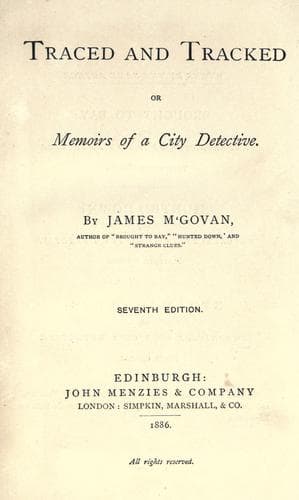
Traced and Tracked; Or, Memoirs of a City DetectiveM'Govan, James
General
Traced and Tracked; Or, Memoirs of a City Detective
M'Govan, James
Detective and mystery stories; Edinburgh (Scotland) -- Fiction
I declined the officious offer, put the fragment in my pocket, and
shortly after took leave with M^cSweeny, who made a dive at once
for the baths in Nicolson Square. A wash in water and a brush at
the fragment seemed to confirm my suspicion. The ivory appeared to
be fine, and was prettily carved, and it seemed to have been rudely
smashed. I took the piece to a dealer in such articles, and he not
only confirmed me in my suspicion, but showed me a complete casket
of the same style of workmanship. It was a small thing, about six
inches long by four broad, and might be used, the dealer said, for
holding either jewels or money. They were very expensive, and but
few were sold. This last bit of information I found to be correct,
for after going over all the dealers in such articles in Edinburgh I
could not find one who had sold a casket answering the description of
the fragment I had found. I wished to find the owner for a particular
reason. In examining the ivory one day it struck me that it had a
smoked appearance—a kind of dingy hue which could never have been
imparted by simply lying among soot. How could it have got that
tinge? Not by being thrown into the fire, for there was not a burn
on the whole fragment. Could Sandy have hung it up his own chimney
like a red herring or a ham to give it that colour, or had it been
so tinged when it came into his possession? The chimney in Sandy’s
house had been the place which we searched most rigorously, so I was
tolerably certain that he had no other interesting herrings there
in pickle. I thought the owner of the bit of ivory and brass might
help me to an answer, and at length decided to advertise for him.
“An Ivory Casket, Carved,” was notified in the newspapers as having
been found, and the owner was requested to call without delay upon
me. The day that this advertisement appeared, Sandy called at Mrs
Nolten’s house in George Square, and asked permission to go up on the
roof to get a rope which he believed he had left there on his last
visit. The request was put before the lady of the house, and promptly
refused. Sandy then went to the next house and made the same request,
and received as prompt a refusal. After the second appearance of the
advertisement, a gentleman named Dundas called, and requested to see
the “Ivory Casket.” There was a strange reserve about him, which I
only understood when in confidence he imparted to me the suspicion
that his own son had been the robber, at the same time emphatically
stating that he was firmly resolved not to give in any charge against
the runaway. On being shown the fragment, he identified it as part
of the lid of an ivory casket stolen from his house, and containing
at that time nearly £10 in gold and silver. The casket had not
been missed till after the flight of his son, who had left a good
situation and gone to London with the craze strong upon him to be an
actor. I found, however, that Mr Dundas had a distinct recollection
Public-domain text, read in full here on John Shaqi.
Reviews
Reviews
No reviews yet
Be the first to share your thoughts on this work.
Elsewhere in the archive
Join the Discussion
Join the discussion
Sign in to leave a comment or review.
Sign InorCreate an account