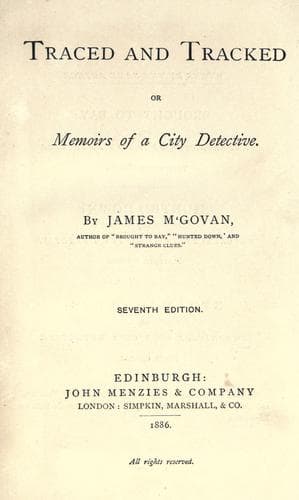
Traced and Tracked; Or, Memoirs of a City DetectiveM'Govan, James
General
Traced and Tracked; Or, Memoirs of a City Detective
M'Govan, James
Detective and mystery stories; Edinburgh (Scotland) -- Fiction
To men of business or wealth, accustomed to handle large sums of
money, bank-notes for large sums—such as £50 or £100—suggest nothing
but convenience of handling and counting. With those who never owned
£50 in their lives it is very different. The sum represented seems
fabulously great—a fortune in itself. And then the thing is so
small—a little oblong square of paper—so compressible—so thin—that
the second stage—that of temptation—easily follows. Fifty or a
hundred pounds in gold would be a good weight to carry, and a sum
difficult to conceal; but a slip of paper! how many cunning and
impenetrable places of hiding could be devised in a few minutes for
that?
I have to give here the adventures of three £50 bank-notes. These
notes had been paid to Mr George Lockyer, a builder, who dabbled a
little in money lending, by a friend in quittance of a bond on some
property. The payer of the money was but a working man, else the
transaction would probably have been settled with a cheque; and the
fact that this man was in working clothes had an important bearing
upon the whole case, apart from the absence of a cheque altogether.
The money had been drawn from the bank, but neither the teller who
paid over the notes nor the receiver of them thought of noting the
numbers.
Mr Lockyer, however, though anything but a careful or methodical man
in regard to money, chanced to notice the number of the top note,
from the fact that it was formed of two twenties, thus—“2020.”
The notes were scarcely opened out—they were quickly counted—the
necessary papers handed over to the payee, and the whole transaction,
and some friendly conversation as well, was all over in about fifteen
minutes.
When the payee was gone, Mr Lockyer lifted the lid of his desk, and
carelessly placed the notes, folded in three, on the top of some
papers, intending to take them out in a short time, and bank them
on his way home to dinner. He did not take them out or bank them—he
forgot all about them. About half an hour later he left the little
office, locking the door after him, and taking the key with him.
This little office was part of a small erection attached to the
building yard. That part which Mr Lockyer used as an office was not
above ten feet square. It was fitted up with two desks, as at times
the builder employed a clerk, but at that time was entered by no one
but himself, or any callers he might have to receive while there.
The remainder of the erection was used as a kind of tool-house, and
was fitted all round with shelves. This apartment entered from the
building yard, and at one time the door between the two places had
been open, but now it was not only closed and locked, but crossed on
the tool-house side by the shelves aforesaid. This door had not been
open for years, and the builder had not even a key for the lock. The
other door, and that now in use, entered from the street, close to
the gate of the yard.
Public-domain text, read in full here on John Shaqi.
Reviews
Reviews
No reviews yet
Be the first to share your thoughts on this work.
Elsewhere in the archive
Join the Discussion
Join the discussion
Sign in to leave a comment or review.
Sign InorCreate an account