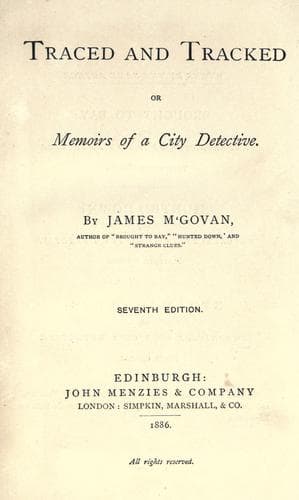
Traced and Tracked; Or, Memoirs of a City DetectiveM'Govan, James
General
Traced and Tracked; Or, Memoirs of a City Detective
M'Govan, James
Detective and mystery stories; Edinburgh (Scotland) -- Fiction
The builder glared about him in a state of great excitement,
imprecating under his breath, and heartily abusing himself for his
carelessness, though he had done the same often before with impunity.
While he sat thus vainly seeking a solution his eye fell upon the
disused door. There was no key to it that he knew of, and the outer
door of the tool-house, entering from the yard, he felt sure was
locked. Still there was a possibility of entrance in that direction,
and that fact set the builder a-thinking. But one man had the entry
of that tool-house—a disabled mason, named John Morley, whom out of
charity he kept employed about the yard. Morley had injured himself
permanently by lifting a heavy weight, and could do little but
look after the things in the yard, and give them out as they were
wanted by the men. Mr Lockyer had known him nearly all his life, and
had never found him to do a dishonest action. Yet still the fact
remained that there was a man, very poorly paid—his wage was 12s. a
week—having a wife and two bairns to keep, and with a possible means
of access to the missing money. Might the money not have been taken
in a moment of strong temptation even by a man like John Morley,
reputed sterling and honest?
“If he has taken it, I can hardly blame him,” was the generous
reflection of the builder. “They have a sair struggle to make ends
meet, I’ve no doubt; and I was a fool to leave the money lying about.
But I never knew him to have a key for that door, and how could he
possibly knew that the money was there, even if he had a key? I had
better act cautiously, as much for my own sake as for his and his
family’s. I must say nothing to the police or any one till I see John
himself.”
Mr Lockyer had been kind to his yard-keeper; he had all but supported
the man and his family during Morley’s illness; then he had devised
how he could employ him at some nominal task by way of making the
man feel less dependent; and lastly, he had promised to assist him
and his family to join a brother abroad who was in a more flourishing
condition and had promised him work suited to his bodily strength.
The builder, therefore, could scarcely believe that the man he had
so helped and shielded could return the kindness by robbing him of
£150; and he locked up his office and turned in the direction of
the yard-keeper’s home, resolved to be as guarded in his words as
possible, so as not to hurt the man’s feelings. Mr Lockyer was a man
who had risen—a bluff, hearty, generous-hearted fellow—and had always
a lenient hand for a working man in difficulties.
Morley’s home was a cellar in Buccleuch Street—a dingy, damp hovel,
lighted by a grating under a shop window. The place was not far from
the yard, and therefore was speedily reached by the builder. Morley
was at home, smoking by the fire, and the bairns were playing in a
corner. The wife was out washing, as she often was, in order to eke
out their income.
Public-domain text, read in full here on John Shaqi.
Reviews
Reviews
No reviews yet
Be the first to share your thoughts on this work.
Elsewhere in the archive
Join the Discussion
Join the discussion
Sign in to leave a comment or review.
Sign InorCreate an account