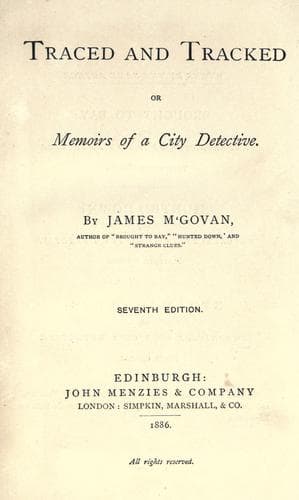
Traced and Tracked; Or, Memoirs of a City DetectiveM'Govan, James
General
Traced and Tracked; Or, Memoirs of a City Detective
M'Govan, James
Detective and mystery stories; Edinburgh (Scotland) -- Fiction
He sat down and finished his porridge with evident zest and appetite,
while we turned over every article in the little den of a house. The
place had not been disturbed so much for many a day. Morley’s wife
seemed much more distressed at the charge than he, and assisted us
with the greatest eagerness and anxious concern. We found no trace
of the notes, and Morley’s manner convinced me that they were not
in the house. He was too cool and careless. Had they been hidden
there—however securely or effectively—he could not have concealed
some perturbation when we came near the spot or grew “hot” in our
little game of “hide and seek.” Just once did I notice anything
like a change in his expression of face. When we had turned over
everything in the house, I chanced to say to Mrs Morley—
“These are all the things you have, I suppose?”
“Oh, yes, sir,” she earnestly answered. “Since John rackit himsel’
we’ve had to make shift with less and less.”
While she thus spoke, I saw her eye run round the room as if in
search of something; then she began poking about with the aid of one
of our lanterns, and finally she turned to her husband and said in a
kind of whisper—
“Where’s the famil——”
She did not get the sentence finished, nor even enough of it to be
intelligible to me. Morley was standing close to her, and whether
he kicked her on the leg, or trod on her toe, or merely gave her
a look, I cannot tell, but he checked her speech most suddenly
and effectually. I just saw enough and heard enough to make me
suspicious, for the den was dark, and I was not expecting the words
so unguardedly uttered by the wife. The last word sounded to me like
“fummel,” and I racked my brains for many an hour after to discover
what on earth a “fummel” was. I had no doubt at all _now_ of Morley’s
guilt, and, of course, I could have arrested him; but what good would
that have done? There was no evidence whatever to support the charge,
and likely to be none with Morley locked up in prison. Besides, I
now felt tolerably certain that the notes were not destroyed, but
concealed in the “fummel”—whatever that meant. I wanted badly to find
that “fummel,” and reasoned that I was more likely to do so with
Morley moving about in freedom than with him cooped up in prison. The
secret of the hiding-place was known to Morley alone; that was quite
evident to me from the eagerness of the wife to assist me, and help
to prove her husband’s innocence, and also by the simplicity with
which she had let out the remark about the “fummel.” I determined
to draw off my men, with so many apologies that Morley should think
himself quite safe from further trouble or suspicion. To confirm this
impression, I directed his master to take no further notice of the
matter, and to keep him in his employment as usual, which was done.
Public-domain text, read in full here on John Shaqi.
Reviews
Reviews
No reviews yet
Be the first to share your thoughts on this work.
Elsewhere in the archive
Join the Discussion
Join the discussion
Sign in to leave a comment or review.
Sign InorCreate an account