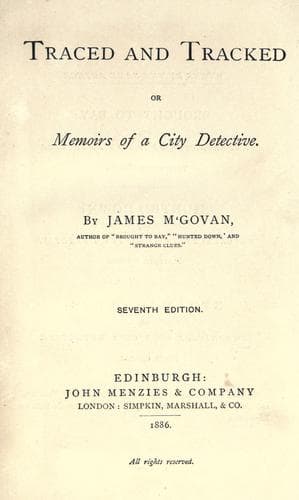
Traced and Tracked; Or, Memoirs of a City DetectiveM'Govan, James
General
Traced and Tracked; Or, Memoirs of a City Detective
M'Govan, James
Detective and mystery stories; Edinburgh (Scotland) -- Fiction
A grand ball was being given one night in November at the mansion
of the Earl of ———, a great castellated place a good bit within
a hundred miles of this city. The dancing room was a perfect
picture—the floor polished mahogany in mosaic work, the walls
panelled in white flowered satin, with gold slips at the edges, and
the whole lighted by hundreds of wax candles inserted in brackets and
chandeliers of cut crystal, glittering with pendants, while flashing
in the head-dresses and on the necks and bosoms of the fair guests
were enough diamonds and other precious stones to have bought up the
Regalia twice over.
It was in this scene of brightness and grandeur, and strictly
exclusive gaiety, that the curious robbery which was to cause me so
much trouble and concern took place.
In an assemblage of this kind, one would expect a thief, if he
managed to get into the place at all, to turn his attention to the
guests and their jewels; but such was not the case, and it was there
that the first puzzling element came into the affair.
At one end of the room, partly in a large recess formed by one of
the bow windows, and partly in a portion of the room screened off by
a rope covered with red cloth, was a raised kind of a dais for the
orchestra. This corner was at the end nearest the door, and clustered
within the rope, with stands and music complete, was an orchestra of
local musicians, under the leadership, for that night only, of a more
distinguished player from England. This gentleman, whom I may name Mr
Cleffton, had been engaged at some high-class concerts in Edinburgh,
and was about to return to England when he was asked as a great
favour and at a high fee to play at this distinguished gathering. To
play at a dancing party was rather out of this gentleman’s line—to
accept a high fee was not, so he went—much to his grief as he soon
found.
About midnight, when the room was beginning to become uncomfortably
warm, the guests filed out grandly to a supper room close by, and
shortly after the musicians were similarly entertained in a smaller
room, to which they were led through a long range of carpeted lobbies
by the butler himself. Most of the players left their instruments on
the seat they had occupied or on the music stand or floor—Mr Cleffton
alone took the trouble to return his to its case. He was about to
shut and lock this for additional security when he chanced to notice
that all the others were waiting on him, and said hurriedly to the
butler—
“I suppose the violins will be perfectly safe here? No one will
meddle them while we’re out?”
The butler smiled lightly at his concern, and said emphatically—
“Not a soul will go near them.”
So the fiddle case was left open and unlocked, and its owner went
away with his companions to regale himself upon cold fowl and tongue
and champagne, or whatever wine he fancied most.
Public-domain text, read in full here on John Shaqi.
Reviews
Reviews
No reviews yet
Be the first to share your thoughts on this work.
Elsewhere in the archive
Join the Discussion
Join the discussion
Sign in to leave a comment or review.
Sign InorCreate an account