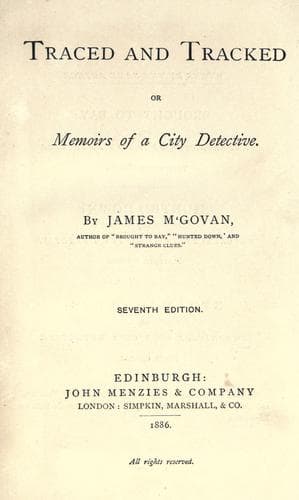
Traced and Tracked; Or, Memoirs of a City DetectiveM'Govan, James
General
Traced and Tracked; Or, Memoirs of a City Detective
M'Govan, James
Detective and mystery stories; Edinburgh (Scotland) -- Fiction
Mr Turner had a craze for buying fiddles which he never did, and
never could, play upon, and I mentally placed him in the same
position as a bibliomaniac, who would sell his soul to get hold of
some old musty volume not worth reading, simply because it happened
to be the only copy in existence. Such a man, I had no hesitation
in deciding, would steal as readily as a man drunk with opium. My
only difficulty was how to make sure that the fiddle had been stolen
at his instigation, and, if that were made clear, how to get at the
stolen article.
The cab stopped at a little hamlet about three miles from the city,
and I was shown into the drawing-room of Mr Turner’s house, in which
we were speedily joined by a dirty-looking man, very shabbily and
raggedly attired, and evidently straight from digging in the garden,
whom I had difficulty in believing to be the wealthy gentleman I had
come to see.
The face was rather repulsive, on the whole, until my companion spoke
of his rare fiddles, when it became animated and bright with the
ruling passion of his life. Then he turned to a cabinet in the room,
and unlocked it as solemnly as if it had been an iron safe full of
diamonds and gold, and brought out several old fiddles, very much
cracked and mended, and every one, if possible, uglier than another,
and which were placed successively in my hands, with a triumphant
look, which evidently meant, “Admire that, or be for ever condemned
as ignorant and stupid.”
I examined them closely as I had been instructed by Mr Cleffton,
and even brightened a little when I found one which had the printed
ticket inside of which he had spoken, but on referring the matter to
my companion, he only smiled and said—
“Oh, that’s a _Strad._, too, but it’s only a copy, and a very poor
one. The other was a _real_ Cremona. By the by, Mr Turner,” he
abruptly added aloud, in response to a signal from me, and while I
pretended to bend over the fiddle in my hand in wrapt devotion and
admiration, “Do you remember that _Stradivarius_ which Cleffton
refused to sell you?”
“Yes; what of it?” The words were somewhat hastily thrown out, and I
fancied I noticed a kind of nervous flutter in his voice as he spoke.
“It has been stolen.”
“Stolen? Impossible!”
These were his words, and natural enough under the circumstances,
but it is impossible to convey in print the whole effect of the
exclamation. There is more in the manner in which words are spoken
than in the words themselves. The appearance of surprise and
incredulity was—or appeared to me to be—manifestly forced; the eyes
of the man had an absent and uneasy expression, as if, while he was
mechanically pronouncing the words, he was saying to himself—“Is
there any danger? Can any one have hinted to him that I might have
been the thief?”
“It is not only possible, but a fact,” pursued my companion.
“And how was it done?” asked Mr Turner, with more coolness.
Public-domain text, read in full here on John Shaqi.
Reviews
Reviews
No reviews yet
Be the first to share your thoughts on this work.
Elsewhere in the archive
Join the Discussion
Join the discussion
Sign in to leave a comment or review.
Sign InorCreate an account