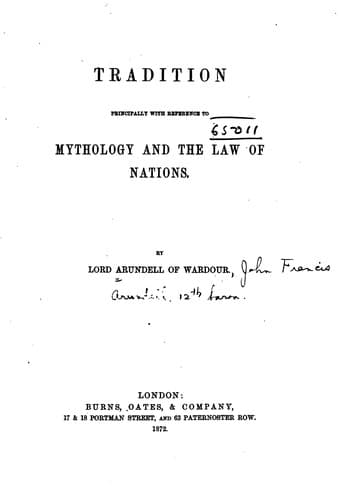
Tradition, Principally with Reference to Mythology and the Law of NationsArundell of Wardour, John Francis Arundell, Baron
Philosophy
Tradition, Principally with Reference to Mythology and the Law of Nations
Arundell of Wardour, John Francis Arundell, Baron
International law; Macdonell, George, 1780-1870; Mythology; Natural law; Tradition (Theology)
I wish also to examine, in greater detail than I should have had space
for in a note, how far the case of the Samoyeds bears out Mr Baring
Gould's theory of the development of idolatry from its grosser to its
more refined manifestations, or of the progress of the human race from
barbarism to the light of religion and of civilisation.
Mr Baring Gould says, p. 136--
"'When a Schaman is aware that I have no household god,' said a
Samoyed to M. Castren, the linguist, 'he comes to me, and I give him a
squirrel, or an ermine skin.' This skin he brings back moulded 'into
a human shape.' ... 'This Los is a fetish; it is not altogether an
idol; it is a spirit entangled in a material object. What that object
is matters little; a stump of a tree, a stone, a rag, or an animal,
serves the purpose of condensing the impalpable deity into a tangible
reality.' Through this coarse superstition glimmers an intelligent
conception. It is that of an all-pervading Deity, who is focussed, so
to speak, in the fetish. This deity is called Num. 'I have heard some
Samoyeds declare that the earth, the sea--all nature, in short--are
Num.' 'Where is Num? asked Castren of a Samoyed, and the man pointed
to the blue sea: but an old woman told him that the sun was Num. The
Siethas, worshipped by the Lapps, had no certain figure or shape formed
by nature or art; they were either trees or rough stones, much _worn
by water_. Tomæus says they were often mere tree stumps with the roots
upwards."[125]
[125] Is not "Num" cognate to "Numen?" and their worship of trees
and worn stones worship of memorials of the Deluge? Compare
Boulanger, _infra_, ch. xi., and on the regard for boulders
in India (_vide_ Gainet, vol. i.) Bryant ("Mythology," iii.
532) says, speaking of the Egyptians--"I have mentioned that
they showed a reverential regard to fragments of rock which
were particularly uncouth and horrid; and this practice seems
to have prevailed in _many other countries_." Probably for the
same reason the Lapps worshipped their lakes and rivers, as is
known from the names annexed to them--"Ailekes Jauvre," that
is, sacred lake, &c. _Vide_ Pinkerton, i. 468. (Leems.)
Public-domain text, read in full here on John Shaqi.
Reviews
Reviews
No reviews yet
Be the first to share your thoughts on this work.
Elsewhere in the archive
Join the Discussion
Join the discussion
Sign in to leave a comment or review.
Sign InorCreate an account