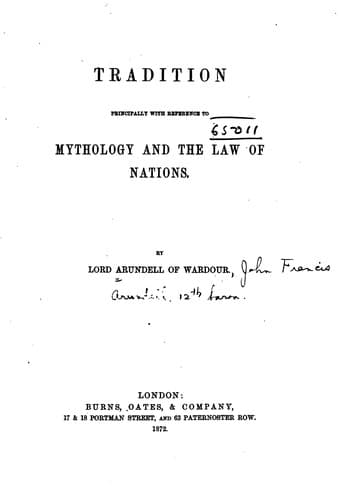
Tradition, Principally with Reference to Mythology and the Law of NationsArundell of Wardour, John Francis Arundell, Baron
Philosophy
Tradition, Principally with Reference to Mythology and the Law of Nations
Arundell of Wardour, John Francis Arundell, Baron
International law; Macdonell, George, 1780-1870; Mythology; Natural law; Tradition (Theology)
368, and note to
Rev. H. J. Coleridge's fourth sermon on "The Latter Days")
that it was not geographically universal. I merely adhere to
the testimony of tradition, and from this point of view it
would suffice (_vide_ Reusch) that it was universal so far as
the horizon of the survivors extended.
Since, however, there is nothing to be said against the possibility of
subsequent partial inundations, there will, I suppose, always be found
persons ready to maintain that the deluges of Ogyges and Deucalion were
partial and historical; although I submit that the arguments which
were formerly used to prove the priority of Ogyges to Deucalion, and
the posteriority of both to the general Deluge, turned upon points of
chronology which will hardly be sustained at the present day.
If, however, I can succeed in showing that the deluge of Deucalion is
identical with the deluge of Noah, I shall consider that I shall have
also proved the point for the deluge of Ogyges, which all agree to have
been much older!
The following is Mr Grote's narrative collating the different
traditions respecting the deluge of Deucalion:--
"Deukalion is important in Grecian mythical narration under two
points of view. First, he is the person specially saved at the time
of the general deluge; next, he is the father of Hellên, the great
eponym of the Hellenic race; at least that was the more current
story, though there were other statements which made Hellên the son
of Zeus." [This was merely the incipient process of the apotheosis
of their more immediate founder.] "The enormous iniquity with
which the earth was contaminated, as Apollodorus says, by the then
existing _brazen_ race, or, as others say, by the fifty monstrous
sons of Sykorôn, provoked Zeus to send a general deluge." "The
latter account is given by Dionys. Halic. i. 17; the former seems
to have been given by Hellenikus, who affirmed that the _ark_
after the Deluge stopped upon Mount Othrys, and not upon Mount
Parnassus (_Schol. Pind. ut supra_), the former being suitable
for a settlement in Thessaly." [I have already pointed out how
the general tradition is everywhere localised.] "An _unremitting_
and _terrible rain_ laid the whole of Greece under water except
the highest mountain-tops, where a few stragglers found refuge.
Deukalion was saved in a chest or ark, which he had been forewarned
by his father Prometheus to construct. After he had floated for
nine days on the water, he at length landed on the summit of Mount
Parnassus. Zeus hearing, sent Hermes to him, promising to grant
whatever he asked. He prayed that men and companions might be
sent him in his solitude: accordingly Zeus directed both him and
Pyrrha to cast stones over their heads, those cast by Pyrrha became
women, those by Deukalion men. And thus the 'stony race of men'
(if we may be allowed to translate an etymology which the Greek
Public-domain text, read in full here on John Shaqi.
Reviews
Reviews
No reviews yet
Be the first to share your thoughts on this work.
Elsewhere in the archive
Join the Discussion
Join the discussion
Sign in to leave a comment or review.
Sign InorCreate an account