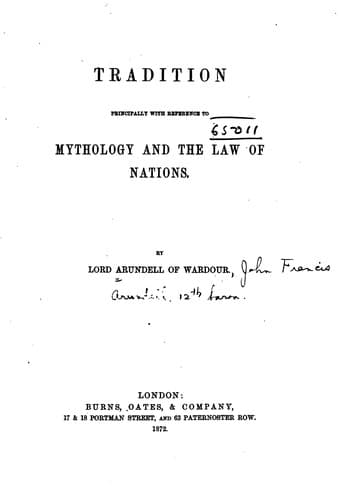
Tradition, Principally with Reference to Mythology and the Law of NationsArundell of Wardour, John Francis Arundell, Baron
Philosophy
Tradition, Principally with Reference to Mythology and the Law of Nations
Arundell of Wardour, John Francis Arundell, Baron
International law; Macdonell, George, 1780-1870; Mythology; Natural law; Tradition (Theology)
Mr Max Müller (comp. "Myth.," "Chips.," ii. 12), incidentally speaking
of the legend of Deucalion, treats it with great contempt. "What is
more ridiculous," he says, "than the mythological account of the
creation of the human race by Deucalion and Pyrrha throwing stones
behind them (a myth which owes its origin to a mere pun on [Greek:
laos] and [Greek: laas])." And ridiculous it certainly is from any
point of view from which Mr Max Müller could regard it, _i.e._ either
as the invention of a mythic period, or as a fugitive allegory arising
out of some astral or solar legend: _per contra_, I shall submit that
there is nothing forced in supposing that this legend arose out of some
one of the processes of corruption to which all tradition is prone, of
the known fact that the human race was re-propagated by Deucalion or
Noah.[189] If I am asked to explain how it came about that there should
have been this identity between the word for a "man" and a "stone,"
I must simply confess my ignorance. Perhaps if Mr Max Müller could
be brought to look at things more from the point of view of biblical
traditions, he might be enabled to see it. All that I can suggest is,
that perhaps it may have a common origin with that Homeric expression
quoted by Mr Max Müller at p. 175 (_vide supra_), "Thou art not
sprung from the olden tree or from the rock." I consider that I shall
definitely establish, however, that it originates in a tradition and
not "a mere pun," and at any rate that it is not local, it is not
Greek. It is no doubt singular that the word for man, [Greek: laos],
populus, should so closely resemble the word for a stone, [Greek:
laas]; but not only is this coincidence found in the Greek, but we
shall see that it is widely spread in all parts of the world. In proof,
I adduce the following extract from Dr Hooker's inaugural lecture at
Norwich in 1868, (since the publication of Mr Max Müller's work):--
"It is a curious fact that the Khasian word for a stone, 'man,' as
commonly occurs in the names of their villages and places as that
of man, maen, and men does in those of Brittany, Wales, Cornwall,
&c.; thus Mansmai signifies in Khasia the Stone of Oath; Manloo,
the Stone of Salt; Manflong, the Grassy Stone; and just as in Wales
Pen mæn maur signifies the Hill of the Big Stone; and in Britanny a
Menhir is a standing stone, and a Dolmen a table stone," &c.[190]
[189] Let the significance of the following coincidence be
considered in connection with the evidence at p. 244,
Boulanger, "Ces fêtes (Atheniasmes, 'Anthisteries') avoient
pour objet une commémoration (of the Deluge) et l'on en
_attribuoit la fondation à Deucalion_; elles étoient _aussi_
consacrées à _Bacchus_, ce qui les a fait nommés les
_anciennes_ ou les _grandes Bacchanales_."--Comp. ch. xi. p.
244, also _supra_, 213.
Public-domain text, read in full here on John Shaqi.
Reviews
Reviews
No reviews yet
Be the first to share your thoughts on this work.
Elsewhere in the archive
Join the Discussion
Join the discussion
Sign in to leave a comment or review.
Sign InorCreate an account