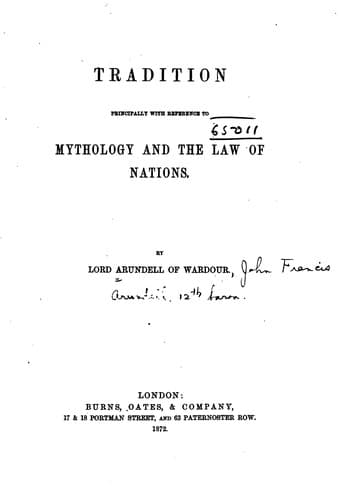
Tradition, Principally with Reference to Mythology and the Law of NationsArundell of Wardour, John Francis Arundell, Baron
Philosophy
Tradition, Principally with Reference to Mythology and the Law of Nations
Arundell of Wardour, John Francis Arundell, Baron
International law; Macdonell, George, 1780-1870; Mythology; Natural law; Tradition (Theology)
[191] Mr Max Müller, in his "Lectures on the Science of Language,"
first series, says of "Man":--"The Latin word 'homo,' the
French 'l'homme' ... is derived from the same root, which we
have in 'humus,' soil, 'humilis,' humble. Homo, therefore,
would express the idea of being made of the dust of the
earth.... There is a third name for man.... 'Ma,' in the
Sanscrit, means to measure.... 'Man,' a derivative root, means
to think. From this we have the Sanscrit 'Manu,' originally
thinker, then man. In the later Sanscrit we find derivations
such as 'Mânava, Mânasha, Manushya,' all expressing man. In
Gothic we find both '_man_,' and 'Maunisk,' the modern German
'maun,' and 'mensch.' There were many more names for man, as
there were many names for all things in ancient language." As
an instance of the correspondence of Old Egyptian and Welsh,
Bunsen's "Philosophy of Univ. Hist.," i. 169, gives "Egyptian,
'man' = rockstone; Welsh, 'maen;' Irish, 'main' (coll. Latin,
'moenia;' Hebrew, 'e-ben')." And (p. 78) Bunsen says--"The
divine Mannus, the ancestor of the Germans, _is absolutely
identical_ with Manus, who, according to ancient Indian
mythology, is the God who created man anew after the Deluge,
_just as Deucalion did_."
[192] The _Saturday Review_, Nov. 14, 1868 (reviewing "The Indian
Tribes of Guiana," by the Rev. W. Brett), says of the Indian
traditions:--"The 'old people's stories' of the creation and
the deluge are highly characteristic.... Under the rule of
Sigu, son of Maikonaima, the tree of life was planted, in
whose stem were pent up the whole of the waters which were to
be let forth by measure to stock every river and lake with
fish. Twarrika, the mischievous monkey, forced open the magic
cover which kept down the waters, and the next minute was
swept away with _all things living_ by the bursting flood.
_The re-peopling_ of the world, as described by the Tamanacs
of the Orinoco _recalls the legend of Deucalion_. One man and
one woman took refuge on the mountain Tama_nacu_. _They then
threw over their heads_ the fruits of the Mauritia (or Ita)
palm, from the _kernel_ of which sprang men and women who once
more peopled the earth."
Public-domain text, read in full here on John Shaqi.
Reviews
Reviews
No reviews yet
Be the first to share your thoughts on this work.
Elsewhere in the archive
Join the Discussion
Join the discussion
Sign in to leave a comment or review.
Sign InorCreate an account