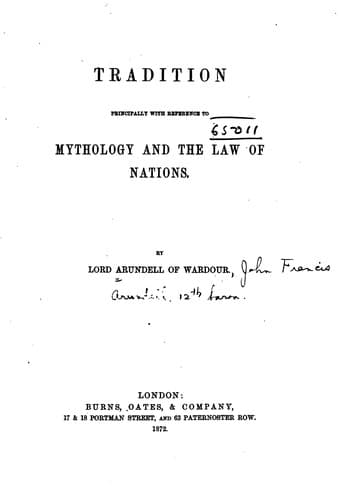
Tradition, Principally with Reference to Mythology and the Law of NationsArundell of Wardour, John Francis Arundell, Baron
Philosophy
Tradition, Principally with Reference to Mythology and the Law of Nations
Arundell of Wardour, John Francis Arundell, Baron
International law; Macdonell, George, 1780-1870; Mythology; Natural law; Tradition (Theology)
[194] "According to the calculations of Varro, the deluge of Ogyges
occurred 400 years before Inachus, _i.e._ 1600 years before
the first Olympiad, which would bring it to 2376 years before
the Christian era; now, according to the Hebrew text, the
Deluge of Noah took place 2349 B.C., which makes only
a difference of 27 years. It is true that many other authors
have reconciled these epochs." Hesiod and Homer are silent
on the subject of both Deucalion and Ogyges.... "It results
from these considerations that the traditions of the ancient
nations of the world confirm the narrative of Genesis, _not
only_ as to the existence, but even as to the _epoch_, of this
catastrophe as fixed by Moses. Mersius (_apud_ Gronovium,
iv. 1023) cites more than twenty ancient authors who speak
of Ogyges as appertaining in their eyes to what was _most
primitive_ in Greece. He is son of Neptune. He is the first
founder of the kingdom of Thebes. Servius represents him _as
coming immediately after Saturn and the golden age_ [which
directly connects Noah with Saturn, and the golden age with
Noah]. Hesychius says of Ogyges that he represented all that
was most ancient in Greece. That, indeed, passed into a
proverb; they said, 'old as Ogyges,' as if they said, 'old as
Adam'" (Gainet, i. 229).
Mr Kenrick says (p. 31):--
"The account of Deucalion, given by Apollodorus (i. 7, 2), bears
evident marks of being compounded of two fables originally
distinct, in one of which, and probably the older, the descent
of the Hellenes was traced through Deucalion to Prometheus and
Pandora, without mention of a deluge. In the other, the destruction
of the brazen race by a flood, the re-peopling the earth by the
casting of stones, is related in the common way. That these two
narratives cannot originally have belonged to the same myths is
evident from their incongruity; for as mankind were created by
Prometheus, the father of Deucalion, there was no time for them
to have passed through those stages of degeneracy by which they
reached the depravity of the brazen age."
Here are evidently two early traditions, ostensibly Greek, distinct,
it is true, yet perfectly compatible. The one the tradition of Grecian
descent through Noah to Adam and Eve, the other the tradition of
the Deluge. But after what we have already seen (_vide supra_, pp.
157, 158) of reduplications and inversions, can a serious argument
be based upon the expression that Deucalion (Noah) was the son of
Prometheus (Adam)?[195] Is it not a most natural and inevitable
_façon-de-parler_ to connect the descendant directly and immediately
with his remote ancestor, _e.g._ "Fils de St Louis--fils de Louis
Capet--montez au ciel!"
Public-domain text, read in full here on John Shaqi.
Reviews
Reviews
No reviews yet
Be the first to share your thoughts on this work.
Elsewhere in the archive
Join the Discussion
Join the discussion
Sign in to leave a comment or review.
Sign InorCreate an account