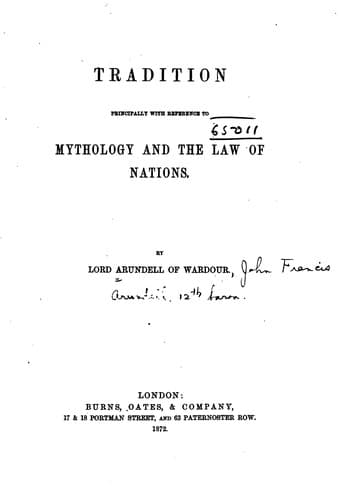
Tradition, Principally with Reference to Mythology and the Law of NationsArundell of Wardour, John Francis Arundell, Baron
Philosophy
Tradition, Principally with Reference to Mythology and the Law of Nations
Arundell of Wardour, John Francis Arundell, Baron
International law; Macdonell, George, 1780-1870; Mythology; Natural law; Tradition (Theology)
[205] I read in the _Times_, March 6, 1871, that "The American
papers state that workmen in Iowa, excavating for the
projected Dubuque and Minnesota railroad, in the limestone
at the foot of a bluff, discovered recently _some caves and
rock chambers_, and, on raising a foot slab, a vault filled
with human skeletons of unusual size, the largest being seven
feet eight inches high. A figured sun on the walls is taken
as indicating that the skeletons belonged to a people who
worshipped that luminary [compare _supra_, p. 152] _and the
representation of a man with a dove stepping out of a boat_,
as an allusion to a tradition of the Deluge. The fingers of
the largest skeleton clasped a pearl ornament, and traces of
cloth were found crumbled at the feet of the remains. Many
copper implements were found, and it is thought that the Lake
Superior mines may have been worked at an early period. The
remains were to be removed to the Iowa Institute of Arts and
Sciences at Dubuque."
Yet, strange to say, this is _no_ proof to Mr Catlin of the universal
Deluge recorded in Scripture. "If," he says, "it were shown that
inspired history of the Deluge and of the Creation restricted those
events to one continent alone, then it might be that the American
races came from the Eastern continent, bringing these traditions
with them, for until that is proved, the American traditions of the
Deluge are no evidence whatever of an eastern origin. If it were
so, and the aborigines of America brought their traditions of the
Deluge from the East, why did they not bring inspired history of the
Creation?"[206]--P. 3. (_Vide_ pp. 134, 135.)
[206] Compare account of Mandan tradition of the Creation, from
"Hist. des Ceremonies Religieuses," _supra_, p. 191.
The "O-kee-pa," Mr Catlin says, "was a strictly religious ceremony,
... with the solemnity of religious worship, with abstinence, with
sacrifices, with prayer; whilst there were three other distinct and
ostensible objects for which it was held,--1. As an annual celebration
of the '_subsiding of the waters_' of the Deluge. 2. For the purpose
of dancing what they call the Bull-dance, to the strict performance
of which they attributed the coming of buffaloes. 3. For purpose of
conducting the young men through _an ordeal of privation and bodily
torture_, which, while it was supposed to harden their muscles and
prepare them for extreme endurance, enabled their chiefs ... to decide
upon their comparative bodily strength, endurance," &c.--P. 9.
Public-domain text, read in full here on John Shaqi.
Reviews
Reviews
No reviews yet
Be the first to share your thoughts on this work.
Elsewhere in the archive
Join the Discussion
Join the discussion
Sign in to leave a comment or review.
Sign InorCreate an account