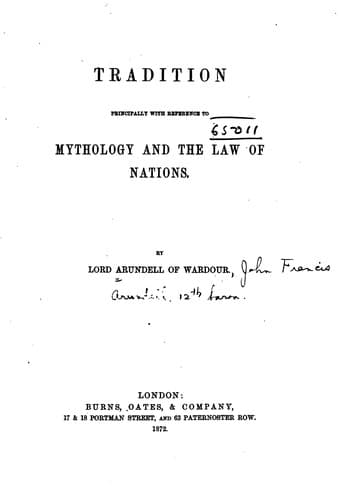
Tradition, Principally with Reference to Mythology and the Law of NationsArundell of Wardour, John Francis Arundell, Baron
Philosophy
Tradition, Principally with Reference to Mythology and the Law of Nations
Arundell of Wardour, John Francis Arundell, Baron
International law; Macdonell, George, 1780-1870; Mythology; Natural law; Tradition (Theology)
[214] Compare (Klaproth, "Mem. Asiat." ii. 12)--Eng. _ox_; Mongol,
char; Hebrew, chor; French, charrue (plough.) Klaproth, ii.
405, "Les cheveux en Thou Khin (whom he identifies with the
Turks) portaient le nom de _Sogo_ ou _so_ko; cest le même
nom que le Turc sâtch ou sadg." Can it have affinity with
Chinese _sa_ (Chinese szu = boeuf sauvage); German, säen;
Swedish, _sá_; French, semer; English = to _sou_; Peruvian,
sara = maize; also French, _cou_dre, to sow with English
corn; Sanscrit, go; High German, chus; Sclavonic, _go_ws
(Max Müller, "Chips," ii. 27); and Kashmir and Dongan,
gau; Icelandic, ku? In Affghan a bull = _sak_hendar and
_souk_handar. In the extinct Tartar Coman (_vide_ Klaproth) ox
= _ogus_ or _seger_ = Turkish, okus; Sanscrit, oukcha; German,
ochse. Plough = Sanscrit, sinam; Irish, serak; Persian, siar.
Horse = _as_p, Persian; _ess_, Sclavonic = English _ass_; and
in Chittral on Indus (_vide_ horse or bull used in ceremonies
on banks of Indus, _infra_) horse = _astor_. (Has not _tor_
here affinity with _taur_eau.) Corn = _As_lek (Kirghish)
and Ashlyk (?) Turkish. Max Müller (Science of Language, p.
231), says--"Aspa was the Persian name for horse, and in the
Scythian names, Aspabota, Aspakara, and Asparatha, we can
hardly fail to recognise the same element." Also, p. 242, "The
comparison of ploughing and sowing is of frequent occurrence
in ancient language." Eng., plough; Sclav., ploug = Sanscrit,
plava, ship = Gk. [Greek: ploion], ship. "In English dialects,
plough is used as a waggon or conveyance. In the Vale of
Blackmore, a waggon is called a plough, or plow, and _Zull_
(A.-S., syl) is used for aratrum."--Barnes, "Dorset Dialect,"
p. 369, ap. Max Müller.
The above enumeration does not exhaust the points of resemblance.
Compare the following:--
BURTON, ii. 23.
"Conspicuous objects on the left of the pavilion
were two Ajalela or fetish pots made by the
present king (according to the customs.) _Vide_
note 16. Both are lamp black, shaped like
amphoræ (amphoræ, for holding wine) about 4 feet
high, and planted on tripods. The larger was
solid, the smaller callendered with many small
holes, and both were decorated with brass and
silver crescents, stars, and similar ornaments.
The second, when filled _with water and
medicine_ allows none to escape, so great is its
fetish power; an army guarded by it can never be
defeated, and it will lead the way to Absokuta."
Compare Pongol ceremony, p. 275.
CATLIN, p. 8.
Public-domain text, read in full here on John Shaqi.
Reviews
Reviews
No reviews yet
Be the first to share your thoughts on this work.
Elsewhere in the archive
Join the Discussion
Join the discussion
Sign in to leave a comment or review.
Sign InorCreate an account