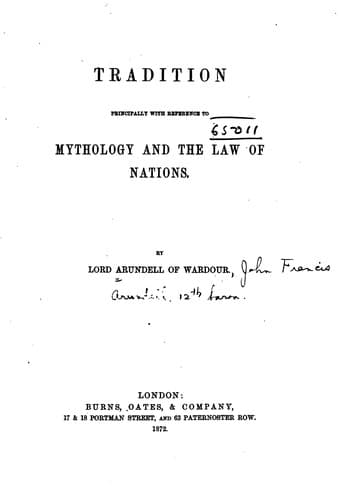
Tradition, Principally with Reference to Mythology and the Law of NationsArundell of Wardour, John Francis Arundell, Baron
Philosophy
Tradition, Principally with Reference to Mythology and the Law of Nations
Arundell of Wardour, John Francis Arundell, Baron
International law; Macdonell, George, 1780-1870; Mythology; Natural law; Tradition (Theology)
[220] I allude to the opening of the ceremony by the centenarian
_white_ man, "the first and only man." Mr Catlin is of opinion
that this incident was introduced and superadded by some
missionaries, though he adds it would be still more strange
if the (Jesuit) missionaries had instructed them "in the
other modes." This, however, is understating the case. It is
conceivable that missionaries should have come among them, but
in this case we should have expected some trace of Christian
practices and dogmas; it is difficult to conjecture what
set of missionaries could have indoctrinated them with the
recondite pagan mysteries of Eleusis and Hierapolis.
I have replied more fully, in chap. vii., to Mr Catlin's
objection--that though they have a tradition of a deluge, it is not the
tradition of the Deluge, because they have not also the tradition of
the Creation.
Mr Catlin argues upon the view that the American race "were created
upon the ground on which they were found" ("Last Rambles," p. 321,
1868); and (p. 319) adds, "I can find nothing in history, sacred or
profane, against this."
He takes his stand (in "O-kee-pa") upon this--that there is nothing in
the Mandan tradition which can be brought in proof of their migration
from another continent. In reply I shall adduce their very name.
The American continent may have been peopled by way of Behring's
Straits, or from Europe in the East by way of Greenland, or by the
connection of the Pacific Islands from the opposite coasts of Japan,
China, and the Corea, or from the Polynesian groups in the south.
The population may have poured in by all these routes. It is said
(Prescott, "Conquest of Mexico," ii. 473)[221] that MSS. exist at
Copenhagen proving that the American coast was visited by the Northmen
in the eleventh century. The Polynesian route we may leave out of
consideration, as it will not probably have been the one by which the
Mandans came. As to the route by Behring's Straits, Mr Catlin admits
"it is a possibility, and therefore they say it is probable" (p. 217,
"Last Rambles"). But if, as there appears to me reason to think, they
came from the opposite coast of the Corea, it might as reasonably be
conjectured that the migration took the route of Behring's Straits,
or by way of the Sandwich Islands. The possibility of the former is
conceded. I will confine my attention, therefore, to the latter, which
Mr Catlin pronounces absolutely impossible. In the first place, the
distance between the Sandwich Islands and America is not greater than
between Otaheite and New Zealand.[222] Now it is admitted that New
Zealand was peopled from Otaheite. Moreover (_vide_ Sir J. Lubbock,
"Pre-historic Times," p. 390), the inhabitants of the Sandwich Islands,
at two thousand miles distance, belong to the same race as those of
Tahiti (Otaheite) and New Zealand, and resemble them "in religion,
Public-domain text, read in full here on John Shaqi.
Reviews
Reviews
No reviews yet
Be the first to share your thoughts on this work.
Elsewhere in the archive
Join the Discussion
Join the discussion
Sign in to leave a comment or review.
Sign InorCreate an account