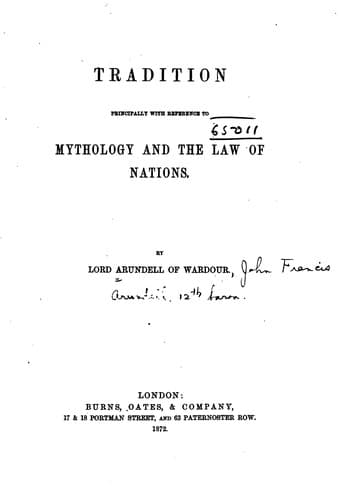
Tradition, Principally with Reference to Mythology and the Law of NationsArundell of Wardour, John Francis Arundell, Baron
Philosophy
Tradition, Principally with Reference to Mythology and the Law of Nations
Arundell of Wardour, John Francis Arundell, Baron
International law; Macdonell, George, 1780-1870; Mythology; Natural law; Tradition (Theology)
These two modes of settlement into communities and states were,
however, essentially dissimilar, and the basis thus laid would have
remained permanently different. The one was the basis of custom, the
other of contract; the one the settlement of the East, the other of
the West; and it will be seen, I think, that whilst the one was more
favourable to the conservation of traditions of religion and history,
the other would have better preserved the tradition of right. These are
points to which I shall return in a subsequent chapter, when I shall
avail myself of the investigations of Sir Henry Maine.
This simple outline, however, of human history, conformable, as I
believe it to be, with the scriptural narrative, conflicts with
at least three theories now much in vogue. The first, which is
substantially that of Sir John Lubbock, Mr Mill,[29] and Mr B. Gould,
is thus conveniently summarised by Mr Hepworth Dixon.[30]
"Every one who has read the annals of our race--a page of nature
with its counterfoil in the history of everything having life--is
aware that, in our progress from the savage to the civilised state,
man has had to pass through three grand stages, corresponding,
as it were, to his childhood, to his youth, and to his manhood.
In the first stage of his career he is a hunter, living mainly
by the chase; in the second, he is a herdsman; ... in the third
stage, he is a husbandman.... Then these conditions of human life
may be considered as finding their purest types in such races as
the Iroquois, the Arabian, the Gothic, in their present stage;
but each condition is, in itself and for itself, _an affair of
development and not of race_. The Arab, who is now a shepherd, was
once a hunter. The Saxon, who is now a cultivator of the soil, was
first a hunter, then a herdsman, before he became a husbandman.
Man's progress from stage to stage is _continuous_ in its course,
_obeying the laws of physical and moral change_. It is slow, it
is _uniform_, it is silent, it is unseen. In one word, it is
_growth_.... These three stages in our progress upward are strongly
marked; the interval dividing an Iroquois from an Arab being as
wide as that which separates an Arab from a Saxon."
Public-domain text, read in full here on John Shaqi.
Reviews
Reviews
No reviews yet
Be the first to share your thoughts on this work.
Join the Discussion
Join the discussion
Sign in to leave a comment or review.
Sign InorCreate an account