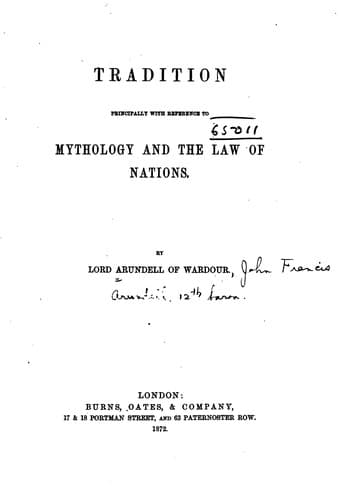
Tradition, Principally with Reference to Mythology and the Law of NationsArundell of Wardour, John Francis Arundell, Baron
Philosophy
Tradition, Principally with Reference to Mythology and the Law of Nations
Arundell of Wardour, John Francis Arundell, Baron
International law; Macdonell, George, 1780-1870; Mythology; Natural law; Tradition (Theology)
[29] This view will be found in the first chapter of Mr J. S.
Mill's "Principles of Political Economy," ch. i. p. 6. "There
is perhaps no people or community now existing which subsist
entirely on the spontaneous produce of vegetation." [Whether
mankind ever lived "entirely on," &c., may be questioned,
but it is implied in Gen. ix. 3 that man did not subsist on
animal food until after the Deluge, a fact which lies at
the foundation of Porphyry's work, "De Abstinentia."] "But
many tribes still live exclusively, or almost exclusively,
on wild animals, the produce of hunting or fishing.... The
first _great advance beyond this state_ consists in the
domestication of the more useful animals: giving rise to the
_the pastoral or nomad state.... From this state of society
to the agricultural_, the transition is not indeed easy (for
no great change in the habits of mankind is otherwise than
difficult, and in general either painful or very slow), but it
lies in what may be called the spontaneous course of events."
[30] Mr Hepworth Dixon's "New America," vol. i. p. 113.
Now, in the first place, I must remark that the Iroquois and the Arab
have never progressed;[31] neither does the Arab at the present show
any signs of a transition to the third stage of necessary growth, nor
does Mr Hepworth Dixon, although he gives some sound practical advice
as to the best mode in which the red man is to be restrained, venture
to suggest any mode by which he is to be reclaimed from the first to
the third stage, either with or without a transition through the second
stage of development. The conclusion therefore, one would think, would
be inevitable that it is an affair _of race_ and _not_ of development.
The Arab and the Iroquois, after the lapse of so many centuries, are
still found with the evidences of primitive life strong upon them; and
so, I imagine, we shall find it wherever we come upon a pure race of
homogeneous origin. On the contrary, we shall find that mixed races,
by the very law and reason of their admixture, have shown the greatest
adaptibility, and, whenever circumstances were favourable, very rapid
growth. Again, I very much question whether the three stages, or rather
three phases of life were ever, as a rule, progressive; and whether,
in the cases in which they might chance to have been successive,
anything occurred in the transition at all resembling an uniform law
of growth. It is very much more probable that the three were from
the earliest period contemporaneous[32]--"and Abel was a shepherd,
and Cain an husbandman" (Gen. iv.)--the determination of the sons to
the avocations of shepherd, husbandman, and hunter respectively (the
latter most probably being the last selected), being influenced by
taste, character, and the division of the inheritance, the authority
of the father, the geographical conditions of the route, and chance
Public-domain text, read in full here on John Shaqi.
Reviews
Reviews
No reviews yet
Be the first to share your thoughts on this work.
Join the Discussion
Join the discussion
Sign in to leave a comment or review.
Sign InorCreate an account