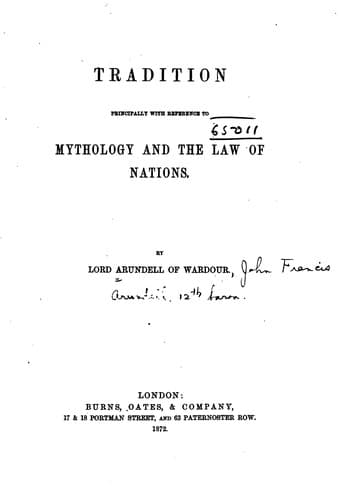
Tradition, Principally with Reference to Mythology and the Law of Nations — John Shaqi
Tradition, Principally with Reference to Mythology and the Law of NationsArundell of Wardour, John Francis Arundell, Baron
Philosophy
Tradition, Principally with Reference to Mythology and the Law of Nations
Arundell of Wardour, John Francis Arundell, Baron
International law; Macdonell, George, 1780-1870; Mythology; Natural law; Tradition (Theology)
Even in the plain of Sennaar (Shinar) we see something of this
fusion of tribes--"Besides these two main constituents of the
Chaldæan race there is reason to believe that both a Semitic
and Aryan element existed.... The subjects of the early kings
are continually designated in the inscriptions by the title
of 'Kiprat-arbat,' which is interpreted to mean 'the four
nations' or 'tongues'" (Rawlinson's "Ancient Monarchies," i.
p. 69). Professor Rawlinson is also of opinion, that "the
league of the four kings in Abraham's time seems correspondent
to a four-fold ethnic division."
Does not the above also correspond to the four-fold ethnic
division of the Vedas?--_Vide infra_, p. 39. Compare also
the four-fold division of the world or of Peru, according
to various Indian traditions, between Manco Capac and his
brothers.--_Vide_ Hakluyt Society's edition of Garcilasso de
la Vega, i. 71-75. If these are not traditions of fusions
of races, they can only be diluvian traditions of the four
couples who came out of the ark, which was the conjecture of
the Spaniards in the case of Manco Capac.
In the situations, however, where the more powerful families had
seized the vantage-ground, or established themselves in the richest
and most coveted valleys, the tendency to consolidation and permanent
settlement would have more rapidly manifested itself. As the tendency
to family dispersion became restrained, and its scope restricted,
disputes as to _meum_ and _tuum_ would have become more frequent
as between families, some more central authority than the family
headship would have been demanded for the protection, discrimination,
and regulation of property. _In these_ instances the state may be
said to have arisen out of the expansion of the family into the
tribes--the families, probably, never having ceased to dwell together
in semi-aggregation; and, when greater concentration was required, they
simply had to fall back upon the patriarchal chieftain. We seem to see
a tradition of this in the Anax Andron.
But equally as regards the rest there must inevitably have come a time
when, as the world became crowded, the same necessity of defending
their possessions, would have caused families, among whom there was no
affinity of race, to coalesce, intermix, succumb, and form communities
and states.
Public-domain text, read in full here on John Shaqi.
Reviews
Reviews
No reviews yet
Be the first to share your thoughts on this work.
Join the Discussion
Join the discussion
Sign in to leave a comment or review.
Sign InorCreate an account