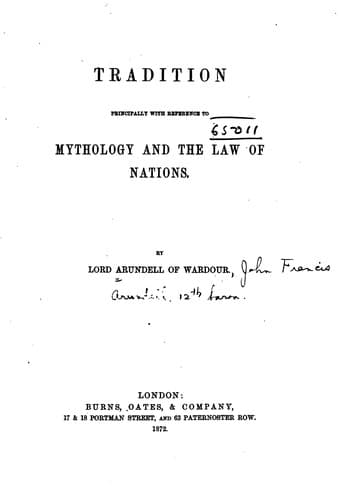
Tradition, Principally with Reference to Mythology and the Law of NationsArundell of Wardour, John Francis Arundell, Baron
Philosophy
Tradition, Principally with Reference to Mythology and the Law of Nations
Arundell of Wardour, John Francis Arundell, Baron
International law; Macdonell, George, 1780-1870; Mythology; Natural law; Tradition (Theology)
circumstances.
[31] _Vide_ Sir S. Baker; _vide_ note, ch. xiii., _Noah_.
[32] The following passage, _inter alia_, from Herodotus seems to
sustain this--"To the eastward _of those Scythians_, who apply
themselves to _the culture of the land_, and on the other side
of the river Panticapes, the country is inhabited by Scythians
who _neither plough nor sow_, but are employed in _keeping
cattle_."--_Herod._, iv., Mel.
And this is the more confirmed when we consider that when once the
hunter started on his career, he would have determined their avocation
also for his posterity. At his death he would not have had herds of
cattle to apportion to any one of his sons, and thus the taste for
wild life, necessarily perpetuated, would be bred in the bone, as an
indomitable characteristic of race, and the first hunter by choice
would inevitably come to be the progenitor of generations of hunters by
instinct and necessity.
The second theory depicts the opening scene of human existence as a
state of conflict, which, it must be allowed, is perfectly consistent
with the theory that it was one of savagery. The theory I am now
combating was originally the theory of Hobbes; and I might have
regarded it as now obsolete, were it not that it has cropped up quite
recently in a most respectable quarter. Mr Hunter, in his charming
work, "The Annals of Rural Bengal," has a passage which, as I think,
has been taken for more than it intends, though not for more than it
expresses. Mr Hunter says, p. 89--
"The inquiry leads us back to that far-off time which we love to
associate with patriarchal stillness. Yet the echoes of ancient
life in India little resemble a Sicilian idyl or the strains of
Pan's pipe, but strike the ear rather as the cries of oppressed and
wandering nations, of people in constant motion and pain. Early
Indian researches, however, while they make havoc of the pastoral
landscapes of Genesis and Job, have a consolation peculiarly suited
to this age. They plainly tell us, that as in Europe so in Asia,
the primitive state of mankind was a state of unrest; and that
civilisation, despite its exactions and nervous city life, is a
state of repose."
Public-domain text, read in full here on John Shaqi.
Reviews
Reviews
No reviews yet
Be the first to share your thoughts on this work.
Join the Discussion
Join the discussion
Sign in to leave a comment or review.
Sign InorCreate an account