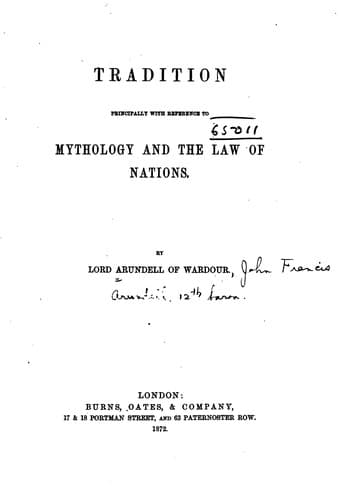
Tradition, Principally with Reference to Mythology and the Law of NationsArundell of Wardour, John Francis Arundell, Baron
Philosophy
Tradition, Principally with Reference to Mythology and the Law of Nations
Arundell of Wardour, John Francis Arundell, Baron
International law; Macdonell, George, 1780-1870; Mythology; Natural law; Tradition (Theology)
[41] Just as Hercules (_vide_ Hercules, p. 180), who embodied
in another line the tradition of Adam, is said by Mr Grote,
"Hist. of Greece," i. p. 128-9, "to have been the most
renowned and most ubiquitous of all the semi-divine personages
worshipped by the Hellenes," so that "distinguished families
are _everywhere_ to be traced who have his patronymic, and
glory in the belief that they are his descendants." To whom
would they trace back more naturally than to Adam?
Well, the (Indian) Aryans also, according to Mr Hunter ("Rural Bengal,"
103), "held (Book of Manu and the Vishnu Purana) that the Greeks
and Persians were sprung from errant Kshatryas, who had lost their
caste"--_i.e._ from their own race. They are called in the same books
_Yavanas_ and Pahlavas. Now no one, I think, will call it a forced
analogy to see in Yavana the name of Javan, the son of Japhet.[42] This
I may call link the second.
[42] This must be taken in connection with what I have said, ch. x.
But the Aryans, as we have seen, are one of the three or four primitive
races to which both philology and ethnology lead us back. They are
contrasted, on the one side, with the Semitic, and, on the other, with
the Hamitic or Turanian race. We will assume, then, on the strength of
the philological and scriptural lines being so nearly conterminous,
that at least, looking from the point of view of Scripture, the Aryan
may be identified with great probability as the Japhetic race. If,
then, the Aryan is the Japhetic race in its elder branch--to which its
later migration would seem to testify--we should exactly expect that it
would designate a kindred but collateral race, not by the name of their
common ancestor, but by the name of the progenitor from whom they were
more immediately descended--not as from Japhet, but from Javan. Thus
the links seem to join; and here I leave them, till there may chance
to come some one who will gather up all the links in the chain of
tradition, dislocated and dispersed by the catastrophes which have been
consequent upon the derelictions of mankind.
The third view to which I wish to advert, is that put forward by Mr
John F. M'Lennan in his "Primitive Marriage," 1865, which also revives
the theory of a savage state, and moreover professes to discover
primitive mankind living in a state of promiscuity, little, if at all,
elevated above the brute, and this during the long period which was
required to develop 1. the tribe; 2. the gens; 3. the family.
It will be difficult for any one, who comes fresh from the perusal of
Genesis, to realise the possibility of such a view being held; but, in
truth, there is no view too grotesque for men in whose survey mankind
appear originally on the scene as a mass of units coming into the
world, no one knows how, like locusts rising above the horizon, or
covering the earth perhaps like toads after a shower!
Public-domain text, read in full here on John Shaqi.
Reviews
Reviews
No reviews yet
Be the first to share your thoughts on this work.
Elsewhere in the archive
Join the Discussion
Join the discussion
Sign in to leave a comment or review.
Sign InorCreate an account