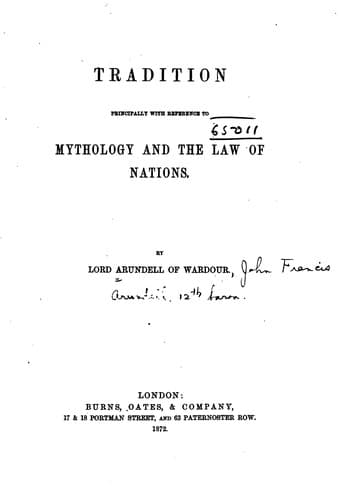
Tradition, Principally with Reference to Mythology and the Law of NationsArundell of Wardour, John Francis Arundell, Baron
Philosophy
Tradition, Principally with Reference to Mythology and the Law of Nations
Arundell of Wardour, John Francis Arundell, Baron
International law; Macdonell, George, 1780-1870; Mythology; Natural law; Tradition (Theology)
[40] Tylor ("Primitive Culture," i. p. 44) says, "The Semitic
family, which represents one of the oldest known civilizations
of the world, includes Arabs, Jews, Phoenicians (?),
Syrians, &c., and may have an older as well as a newer
connection in North Africa. This family takes in some rude
tribes, but _none which would be classed as savages_. The
Aryan family has existed in Asia and Europe certainly for
several thousand years, and there are well known and marked
traces of early barbaric condition, which has perhaps survived
with least change among secluded tribes in the valleys of the
Hindu Kush and Himalaya." [_Query_, What is the nature of the
evidence that they have survived, and have not degenerated?]
Mr Tylor continues, "There seems, again, _no known case of
any full Aryan tribe having become savage_. The gipsies and
other outcasts are, no doubt, partly Aryan in blood, but
_their degraded condition_ is not _savagery_. In India there
are tribes Aryan by language, but whose physique is rather of
indigenous type, and whose ancestry is mainly from indigenous
stocks, with more or less mixture of the dominant Hindu."
Compare _infra_, ch. v., and De Maistre, p. 272.
In truth, it appears to us a self-evident proposition, simply because
tradition has familiarised us with the belief that Europe was peopled
by the descendants of Japhet, and because philology has recently
demonstrated the Indo-Germanic race to include this demarcation
(together with Central and Western Asia); but I think that if we
exclude the testimony of tradition, we should have difficulty in
establishing the point either upon the text of Gen. x. 5, or from the
evidence of philology.
That the race of Japhet spread themselves over the islands, and
colonised the coasts of the Mediterranean, is the traditional
interpretation of that text; and it receives confirmation, in the first
place, in the tradition that "Japetus being the father of Prometheus,
was regarded by the Greeks as the ancestor of the human race."--Smith's
"Myth. Dict." We have, I think, become familiar with such
transpositions as "Deucalion the son of Prometheus," and "Prometheus
the son of Deucalion," &c. Certainly Prometheus (_vide_ Appendix to
Chap. viii. p. 180, and Chap. x. p. 232), supposing Prometheus to be
Adam,[41] would naturally stand at the head of every genealogy; but
Japetus, supposing him to be identified with Japhet as the particular
founder of the race (after so distinct and definite a starting-point
as the Deluge), would also, in his way, have claims to be placed at
the head of their genealogy; and probably about the time that he began
to be called "old Japetus," and to be typical of antiquity, his claims
would have been regarded as paramount, and Prometheus would have been
accordingly displaced in his favour. This is conjectural, but must be
taken as one link.
Public-domain text, read in full here on John Shaqi.
Reviews
Reviews
No reviews yet
Be the first to share your thoughts on this work.
Elsewhere in the archive
Join the Discussion
Join the discussion
Sign in to leave a comment or review.
Sign InorCreate an account