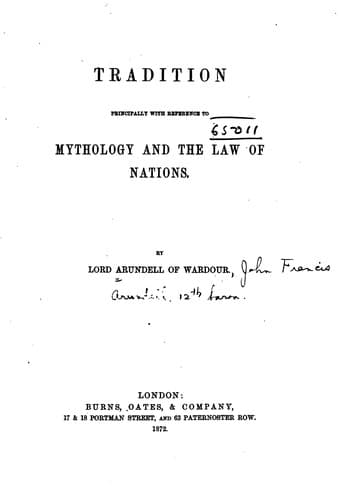
Tradition, Principally with Reference to Mythology and the Law of NationsArundell of Wardour, John Francis Arundell, Baron
Philosophy
Tradition, Principally with Reference to Mythology and the Law of Nations
Arundell of Wardour, John Francis Arundell, Baron
International law; Macdonell, George, 1780-1870; Mythology; Natural law; Tradition (Theology)
Mr M'Lennan (p. 29), with reference to the hurling "stones and
bamboos at the head of the devoted bridegroom in Khondistan,"
says, "_the hurling of old shoes_ after the bridegroom among
ourselves _may be_ a relic of a similar custom." But this
custom would seem to be much more directly traced to the
custom among the Jews of taking the shoes from the man who
refused to marry his brother's widow (Deuteronomy), and which
is more generally stated in Ruth iv. 7, as a token of _cession
of right_--"the man _put off his shoe_, and gave it to his
neighbour, _this was the testimony of a cession of right in
Israel_" (Ruth iv. 7).
This compels the remark that if Mr M'Lennan fails to prove that exogamy
was universal, as a stage of human progress, or, to use a phrase of
his own, "on such a scale as to entitle it to rank among the normal
phenomena of human development," there is nothing to exclude the
likelihood of its being much more satisfactorily and directly traced
as the result of degeneracy. Mr M'Lennan should clear his ground by
demonstrating that the circumstances exclude the possibility of this
conjecture.
On the contrary, and on his own showing, they would appear much more
certainly to affirm it. Although exogamy is the earliest fact which
he believes to be demonstrable by evidence, he assumes an initial
promiscuity; and seems to see his way out of this initial promiscuity
through the system of "rude polyandry" (when one woman was common to a
determinate number of men unrelated) as distinguished from "regulated
polyandry" (where one woman was common to several brothers). It must
be noted that before these polyandrous families, if we may so call
them, at first necessarily limited, could theoretically or in fact have
become the tribal exogamous groups, many difficulties must be disposed
of, and many stages traced, of which we are told nothing more than that
we are "forced to regard all the exogamous races as having originally
been polyandrous" (p. 226). That these families, if it is not an abuse
of terms to call them so, could not have become tribal by grouping, Mr
M'Lennan himself maintains, p. 232.
Public-domain text, read in full here on John Shaqi.
Reviews
Reviews
No reviews yet
Be the first to share your thoughts on this work.
Elsewhere in the archive
Join the Discussion
Join the discussion
Sign in to leave a comment or review.
Sign InorCreate an account