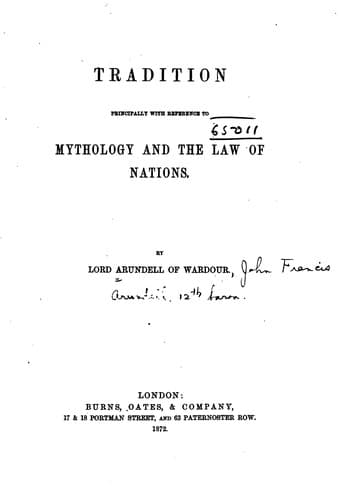
Tradition, Principally with Reference to Mythology and the Law of NationsArundell of Wardour, John Francis Arundell, Baron
Philosophy
Tradition, Principally with Reference to Mythology and the Law of Nations
Arundell of Wardour, John Francis Arundell, Baron
International law; Macdonell, George, 1780-1870; Mythology; Natural law; Tradition (Theology)
The two systems which Mr M'Lennan distinguishes as "rude" and
"regulated polyandry," are so essentially different that I fail to
trace the possibility of progression from one to the other. "Rude
polyandry" is barely distinguishable from promiscuity, and not at
all if we regard it as only promiscuity, necessarily limited through
infanticide, or other causes destroying the balance of the sexes. The
latter has peculiar features--arising in some way out of, and fixed
in the idea of the relationship of brothers--an idea which it is just
conceivable might arise directly out of a state of promiscuity--where
theoretically the children might be supposed to be in contact with the
mother only, but which the system of "rude polyandry," by introducing
conflicting and complicated claims, would immediately tend to weaken
and obliterate.
Let us see, then, if we can trace the custom better on the lines of
degeneracy.
If we start with the belief in the existence of many primitive
ceremonies and regulations we may then suppose that in the downward
progression to promiscuity, the stages of the descent will be traceable
in the corruptions of these customs. Such surmises at least are as
good as the contrary surmises of Mr M'Lennan.
Now, we have already seen[44] that Mr M'Lennan alludes to the law
of Deuteronomy, which imposed the obligation of the younger brother
marrying the widow of the elder--and it will, moreover, be seen (Mr
M'Lennan, p. 219) that this was also prescribed in the law of Menu.
[44] "Dr Latham would invert the order of development by producing
the ruder fact--polyandry--from the less rude obligation. But
clearly this is an inversion of the order of nature, _which is
progressive_," &c.--_M'Lennan_, "_Prim. Marriage_," p. 206.
Whatever may be the true solution of this coincidence the least likely
account would seem to be that they had both, under different conditions
(different at any rate from the point of divergence, be it exogamy
or polyandry), advanced to it independently and by similar stages.
Such fortuitous coincidences would imply not merely a succession of
similar developments, but also a corresponding succession of accidental
circumstances.
Public-domain text, read in full here on John Shaqi.
Reviews
Reviews
No reviews yet
Be the first to share your thoughts on this work.
Elsewhere in the archive
Join the Discussion
Join the discussion
Sign in to leave a comment or review.
Sign InorCreate an account