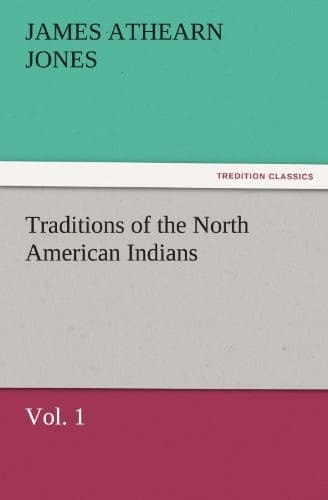
Traditions of the North American Indians, Vol. 1Jones, James Athearn
History
Traditions of the North American Indians, Vol. 1
Jones, James Athearn
Indians of North America -- Folklore
When the Minnatarees arrived in the upper air, they established
themselves on the spot where they now reside. Very soon after, a party
of strange men appeared among them, mounted on animals, or rather they
seemed a part of strange animals, with four legs, possessed of great
fleetness, and whose long and beautiful tails swept the earth where they
trod. They attacked the wonderful creatures with their bows and arrows,
and succeeded in killing one of them, upon which the others ran away.
Not at first perceiving that the man and horse were two distinct
animals, how much were they surprised to see the former fall to the
earth, as if one part of the compound of the animal was dead, and the
other still active, having received no injury. They at length succeeding
in capturing the horse, and, after admiring the beauty of his form, and
becoming familiar with him, they proceeded to tie one of their young men
upon his back with cords that he might not fall off. The horse was then
led cautiously by the halter until he became sufficiently tame to ride
alone, and without a leader. It was in this manner that our nation
procured the horse, and from this one sprung the breed we now have.
Brothers, this is what our fathers told us of the manner in which the
Minnatarees and other Indian tribes became possessed of their present
hunting-grounds, and of the way in which our nation procured the
horse.--I have done.
NOTES.
(1) _The Hissing-Snake_.--p. 201.
This snake is the most remarkable of the different species of snake that
infest the western wilds. It is of the small speckled kind, and about
eight inches long. When any thing approaches, it flattens itself in a
moment, and its spots, which are of various dyes, become visibly
brighter through rage; at the same time it blows from its mouth, with
great force, a subtle wind, that is reported to be of a nauseous smell,
and, if drawn in with the breath of the unwary traveller, it is said,
will infallibly bring on a decline, that in a few months must prove
mortal. So says Carver.
(2) _Feast of rejoicing for their death_.--p. 204.
The early travellers report, that some of the tribes on the banks of the
Mississippi, in the words of the text, "celebrated the death of a man
with great rejoicing."
LOVE AND WAR.
Public-domain text, read in full here on John Shaqi.
Reviews
Reviews
No reviews yet
Be the first to share your thoughts on this work.
Elsewhere in the archive
Join the Discussion
Join the discussion
Sign in to leave a comment or review.
Sign InorCreate an account