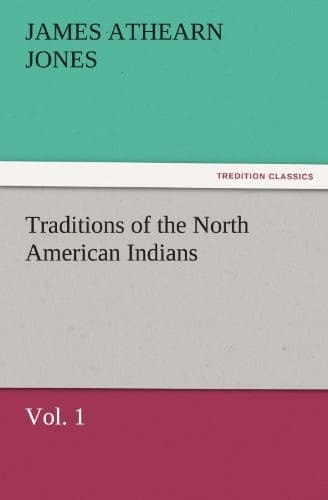
Traditions of the North American Indians, Vol. 1Jones, James Athearn
History
Traditions of the North American Indians, Vol. 1
Jones, James Athearn
Indians of North America -- Folklore
When the great man had thus filled the earth with living creatures, he
called the mother of the world to him, and gave to her and her offspring
the things which he had created, with full power to kill, eat, and never
to spare, telling her that he had commanded them to multiply for her use
in abundance. When he had finished speaking, he returned to the place
whence he came, and has never been heard of since. In due time, the
mother of the world was delivered of two children, a son and a daughter,
both having the dark visage of the Indian race, and from them proceeded
the Dog-ribs, and all the other nations of the earth. The white men
were from the same source, but the father of them, having once upon a
time been caught stealing a beaver-trap, he become so terrified that he
lost his original colour and never regained it, and his children remain
with the same pale cheeks to this day.
Brothers, I have told you no lie.
NOTE.
* * * * *
(1) _Never stole a beaver-trap._--p. 76.
Thieving is considered disreputable among the Indians; that is, it is
highly criminal and infamous to steal from each other. Thieves are
compelled to restore what they have stolen, or to make satisfactory
amends to the injured party; in their default, their nearest relations
are obliged to make up the loss. If the thief, after sufficient warning,
continues his bad practices, he is disowned by his nation, and any one
may put him to death the next time he is caught in the act of stealing,
or that a theft can be clearly proved to have been committed by him. "I
once," says Heckewelder, "knew an Indian chief who had a son of a
vicious disposition, addicted to stealing, and would take no advice. His
father, tired and unable to satisfy all the demands which were made upon
him for the restitution of articles stolen by his son, at last issued
his orders for shooting him, the next time be should be guilty of a
similar act"--_Heckew_., 328.
Theft is always looked upon as a blot which dishonours a family, and
every one has a right to wash away the stain with the blood of the
delinquent. "Father Breboeuf," says Charlevoix, (vol. ii. p. 28) "one
day saw a young Huron who was killing a woman with a club; he ran to
him to prevent him, and asked him why he committed such violence. 'She
is my sister,' replied the savage; 'she is guilty of theft, and I will
expiate by her death the disgrace she has brought upon me and all my
family.'"
THE FALL OF THE LENAPE
Public-domain text, read in full here on John Shaqi.
Reviews
Reviews
No reviews yet
Be the first to share your thoughts on this work.
Elsewhere in the archive
Join the Discussion
Join the discussion
Sign in to leave a comment or review.
Sign InorCreate an account