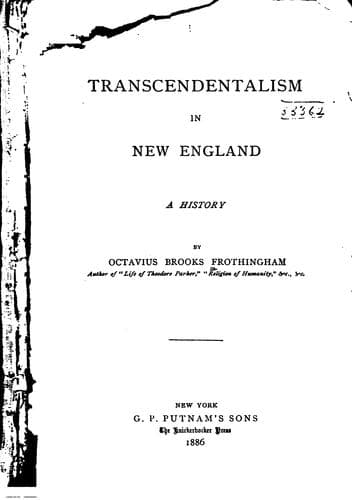
Transcendentalism in New England: A HistoryFrothingham, Octavius Brooks
Philosophy
Transcendentalism in New England: A History
Frothingham, Octavius Brooks
Transcendentalism (New England)
It remains to thank you for the goodness you have uniformly
extended towards me, for your forgiveness of many defects, and your
patient and even partial acceptance of every endeavor to serve you;
for the liberal provision you have ever made for my maintenance;
and for a thousand acts of kindness which have comforted and
assisted me.
To the proprietors I owe a particular acknowledgment, for their
recent generous vote for the continuance of my salary, and hereby
ask their leave to relinquish this emolument at the end of the
present month.
And now, brethren and friends, having returned into your hands the
trust you have honored me with,--the charge of public and private
instruction in this religious society--I pray God, that, whatever
seed of truth and virtue we have sown and watered together, may
bear fruit unto eternal life. I commend you to the Divine
Providence. May He grant you, in your ancient sanctuary the service
of able and faithful teachers. May He multiply to your families and
to your persons, every genuine blessing; and whatever discipline
may be appointed to you in this world, may the blessed hope of the
resurrection, which He has planted in the constitution of the human
soul, and confirmed and manifested by Jesus Christ, be made good
to you beyond the grave. In this faith and hope I bid you farewell.
Your affectionate servant,
RALPH WALDO EMERSON.
Mr. Emerson's place is among poetic, not among philosophic minds. He
belongs to the order of imaginative men. The imagination is his organ.
His reading, which is very extensive in range, has covered this
department more completely than any. He is at home with the seers,
Swedenborg, Plotinus, Plato, the books of the Hindus, the Greek
mythology, Plutarch, Chaucer, Shakspeare, Henry More, Hafiz; the books
called sacred by the religious world; "books of natural science,
especially those written by the ancients,--geography, botany,
agriculture, explorations of the sea, of meteors, of astronomy;" he
recommends "the deep books." Montaigne has been a favorite author on
account of his sincerity. He thinks Hindu books the best gymnastics for
the mind.
His estimate of the function of the poetic faculty is given in his
latest volume.
Public-domain text, read in full here on John Shaqi.
Reviews
Reviews
No reviews yet
Be the first to share your thoughts on this work.
Elsewhere in the archive
Join the Discussion
Join the discussion
Sign in to leave a comment or review.
Sign InorCreate an account