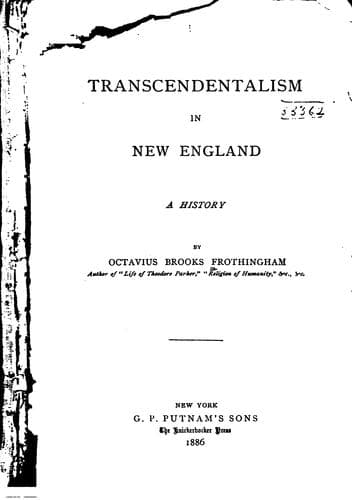
Transcendentalism in New England: A HistoryFrothingham, Octavius Brooks
Philosophy
Transcendentalism in New England: A History
Frothingham, Octavius Brooks
Transcendentalism (New England)
The first article in Mr. Emerson's faith is the primacy of Mind. That
Mind is supreme, eternal, absolute, one, manifold, subtle, living,
immanent in all things, permanent, flowing, self-manifesting; that the
universe is the result of mind, that nature is the symbol of mind; that
finite minds live and act through concurrence with infinite mind. This
idea recurs with such frequency that, but for Emerson's wealth of
observation, reading, wit, mental variety and buoyancy, his talent for
illustration, gift at describing details, it would weary the reader. As
it is, we delight to follow the guide through the labyrinth of his
expositions, and gaze on the wonderful phantasmagoria that he exhibits.
His second article is the connection of the individual intellect with
the primal mind, and its ability to draw thence wisdom, will, virtue,
prudence, heroism, all active and passive qualities. This belief, as
being the more practical, has even more exuberant expression than the
other:
"The relations of the soul to the divine spirit are so pure that it
is profane to seek to interpose helps. Whenever a mind is simple,
and receives a divine wisdom, all things pass away--means,
teachers, texts, temples fall; it lives now, and absorbs past and
future into the present hour."
"Let man learn the revelation of all nature and all thought to his
heart; this, namely: that the highest dwells with him; that the
sources of nature are in his own mind, if the sentiment of duty is
there."
"Ineffable is the union of man and God in every act of the soul;
the simplest person who, in his integrity, worships God, becomes
God; yet for ever and ever the influx of this better and universal
self is new and unsearchable."
"We are wiser than we know. If we will not interfere with our
thought, but will act entirely, or see how the thing stands in God,
we know the particular thing, and every thing, and every man. For
the Maker of all things and all persons stands behind us, and casts
His dread omniscience through us over things."
"The only mode of obtaining an answer to the questions of the
senses, is to forego all low curiosity, and, accepting the tide of
being which floats us into the secret of nature, work and live,
work and live, and all unawares the advancing soul has built and
forged for itself a new condition, and the question and the answer
are one."
"We are all discerners of spirits. That diagnosis lies aloft in our
life or unconscious power."
Public-domain text, read in full here on John Shaqi.
Reviews
Reviews
No reviews yet
Be the first to share your thoughts on this work.
Elsewhere in the archive
Join the Discussion
Join the discussion
Sign in to leave a comment or review.
Sign InorCreate an account