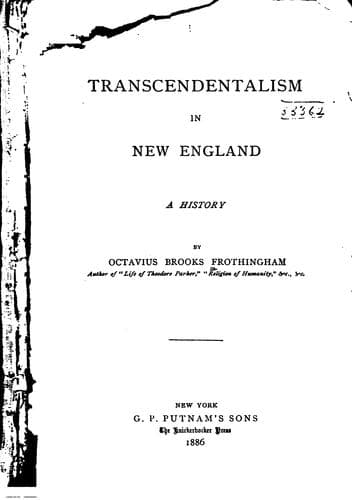
Transcendentalism in New England: A HistoryFrothingham, Octavius Brooks
Philosophy
Transcendentalism in New England: A History
Frothingham, Octavius Brooks
Transcendentalism (New England)
In the journals of Theodore Parker, Mr. Alcott is represented as taking
an active part in the thinking and talking of the period immediately
preceding the establishment of the "Dial," and as expressing audacious
opinions; among others, this--which suggests Hegel, though it might have
reached Mr. Alcott from a different quarter--that the Almighty
progressively unfolds himself towards His own perfection; and this, that
the hideous things in nature are reflections of man's animalism; that
the world being the product of all men, man is responsible for its evil
condition; a doctrine similar to the Augustinian doctrine of the Fall,
hinted at also in the Book of Genesis. It was the doctrine of Jacob
Boehme, one of Mr. Alcott's seers, that as the inevitable consequence of
sin, the operation of the Seven Qualities in Lucifer's dominion became
perverted and corrupted. The fiery principle, instead of creating the
heavenly glory, produced wrath and torment. The astringent quality, that
should give stability and coherence, became hard and stubborn. The sweet
was changed to bitter; the bitter to raging fury. This earth--once a
province of the heavenly world--was broken up into a chaos of wrath and
darkness, roaring with the din of conflicting elements. Eden became a
waste; its innocence departed, its friendly creatures began to bite and
tear one another, and man became an exile and a bondsman to the elements
he once controlled.
In 1837 Mr. Alcott--not Mr. Emerson--was the reputed leader of the
Transcendentalists, none being more active than he in diffusing the
ideas of the Spiritual Philosophy, and none being so uncompromising in
his interpretations of them. He was generally present at the meetings of
the informal Club which, under different names, held meetings at the
private houses of members, from 1836 to 1850. Mr. Ripley had
consultations with him in regard to the proposed community which was
later established at Brook Farm. When Mr. Garrison founded the American
Anti-Slavery Society, Mr. Alcott joined that cause, and was faithful to
it till the end. With the movement for the emancipation and elevation of
women, he was a sympathizer. He was one of the reformers who met at
Chardon Street Chapel, in 1840, to discuss plans of universal
reform--Garrison, Edmund Quincy, Henry C. Wright, Theodore Parker,
William H. Channing, Christopher Greene, Maria Chapman and Abby Kelly
being of the number. In those days he was intimate with Emerson, Ripley,
Hedge, Brownson, Clarke, Bartol, Stetson, and well known as a leader in
speculative thought. His period of Pythagorean discipline had already
begun. In 1835 he put away the use of animal food. Declining to join
either the Brook Farm community, or that of Adin Ballou, at Milford, he
undertook to do his part towards the solution of the "labor and culture
problem," by supporting himself by manual labor in Concord, working
during the summer in field and garden, and in winter chopping wood in
Public-domain text, read in full here on John Shaqi.
Reviews
Reviews
No reviews yet
Be the first to share your thoughts on this work.
Elsewhere in the archive
Join the Discussion
Join the discussion
Sign in to leave a comment or review.
Sign InorCreate an account