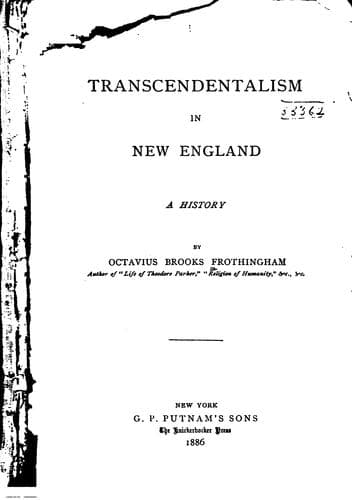
Transcendentalism in New England: A HistoryFrothingham, Octavius Brooks
Philosophy
Transcendentalism in New England: A History
Frothingham, Octavius Brooks
Transcendentalism (New England)
I look upon this fact as very natural in the circumstances of the
church. The disciples lived together; they threw all their property into
a common stock; they were bound together by the memory of Christ, and
nothing could be more natural than that this eventful evening should be
affectionately remembered by them; that they, Jews like Jesus, should
adopt his expressions and his types, and furthermore, that what was done
with peculiar propriety by them, his personal friends, with less
propriety should come to be extended to their companions also. In this
way religious feasts grew up among the early Christians. They were
readily adopted by the Jewish converts who were familiar with religious
feasts, and also by the Pagan converts whose idolatrous worship had been
made up of sacred festivals, and who very readily abused these to gross
riot, as appears from the censures of St. Paul. Many persons consider
this fact, the observance of such a memorial feast by the early
disciples, decisive of the question whether it ought to be observed by
us. For my part I see nothing to wonder at in its originating with them;
all that is surprising is that it should exist among us. There was good
reason for his personal friends to remember their friend and repeat his
words. It was only too probable that among the half converted Pagans and
Jews, any rite, any form, would find favor, whilst yet unable to
comprehend the spiritual character of Christianity.
The circumstance, however, that St. Paul adopts these views, has seemed
to many persons conclusive in favor of the institution. I am of opinion
that it is wholly upon the epistle to the Corinthians, and not upon the
Gospels, that the ordinance stands. Upon this matter of St. Paul's view
of the Supper, a few important considerations must be stated.
The end which he has in view, in the eleventh chapter of the first
epistle is, not to enjoin upon his friends to observe the Supper, but to
censure their abuse of it. _We_ quote the passage now-a-days as if it
enjoined attendance upon the Supper; but he wrote it merely to chide
them for drunkenness. To make their enormity plainer he goes back to the
origin of this religious feast to show what sort of feast that was, out
of which this riot of theirs came, and so relates the transactions of
the Last Supper. "_I have received of the Lord_," he says, "_that which
I delivered to you_." By this expression it is often thought that a
miraculous communication is implied; but certainly without good reason,
if it is remembered that St. Paul was living in the lifetime of all the
apostles who could give him an account of the transaction; and it is
contrary to all reason to suppose that God should work a miracle to
convey information that could so easily be got by natural means. So that
the import of the expression is that he had received the story of an
eye-witness such as we also possess.
Public-domain text, read in full here on John Shaqi.
Reviews
Reviews
No reviews yet
Be the first to share your thoughts on this work.
Elsewhere in the archive
Join the Discussion
Join the discussion
Sign in to leave a comment or review.
Sign InorCreate an account