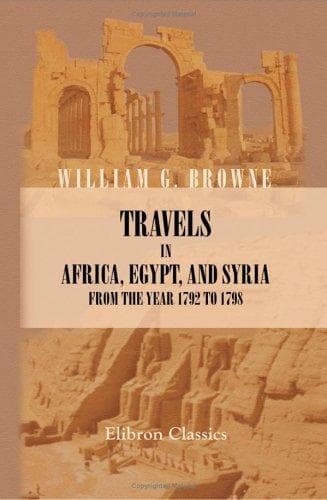
Travels in Africa, Egypt, and Syria, from the year 1792 to 1798Browne, William George
History
Travels in Africa, Egypt, and Syria, from the year 1792 to 1798
Browne, William George
Egypt -- Description and travel; Sudan -- Description and travel; Syria -- Description and travel
The two largest of the pyramids are at about the distance of two
hours and a half from Jizé, and are well known to all who have
visited Egypt. The dimensions of that which has been opened I found
to be as follow:
Feet. Inches.
Great chamber 34 5
Breadth 17 2
Sarcophagus 7 8
Breadth 3 2
Depth within 2 10½
Thickness 0 6
The galleries and great chamber are situated due North and South,
allowing for the variation of the needle.
Feet. Inches.
The first passage descending 105 1
Small chamber, length 18 9
-------------- breadth 17 1
Antichamber, length 7 5
Main gallery, upper part 150 0
------------- lower part 148 0
Passage to inferior chamber 109 1
An absurd opinion has recently been stated, that the pyramids are
hewn out of the rock on which they stand; but the first ocular
inspection would set this aside, the joinings of the stones being
everywhere marked with cement. But it is unnecessary to dwell on a
conjecture so futile.
In the open pyramid, the chamber is lined with granite, and the
sarcophagus also formed of that stone. But the materials used in
the general fabrication of these edifices is free-stone, of a soft
kind and white hue; it is replete with shells. The rock on which
they stand is of the same soft stone. Returned to Kahira.
On another occasion I visited the pleasant site of the antient
Memphis, on the left bank of the Nile, about two hours to the South of
Kahira, in a plain above three miles broad, between the river and the
mountains. The land is now laid down in corn, with date trees toward
the mountains. Nothing remains except heaps of rubbish, in which are
found pieces of sculptured stone. The spot has been surrounded with
a canal, and seems every way a more eligible situation than that of
Kahira[31]. Its extent might be marked by that of the ground where
remains are dug up, and which is always overgrown with a kind of
thistle that seems to thrive among ruins. It is most conveniently
visited from the Coptic convent called _Abu-Nemrûs_.
None of the fine marbles that are scattered so profusely at Alexandria
are discoverable here; whether it be that they were never used,
or carried away to adorn other places.
Of the several capitals of Egypt in successive ages, Thebes, or
Diospolis, seems the most antient. Next was Memphis, itself a city
of the most remote antiquity. Babylon seems to have been only the
capital of a part retained by the Persians, after Cambyses had subdued
Egypt, and was, by all accounts, founded by the Persians. Alexandria
succeeded Memphis, and remained the chief city, till the Saracens
founded _Misr-el-Kahira_.
CHAP. XIV.
JOURNEY TO SINAI.
Public-domain text, read in full here on John Shaqi.
Reviews
Reviews
No reviews yet
Be the first to share your thoughts on this work.
Elsewhere in the archive
Join the Discussion
Join the discussion
Sign in to leave a comment or review.
Sign InorCreate an account