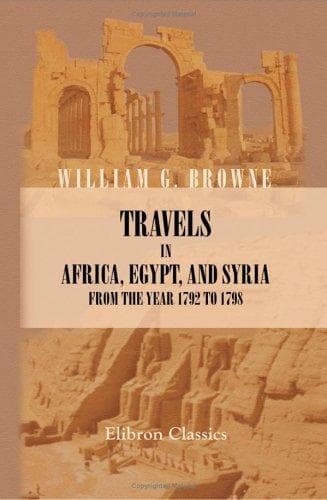
Travels in Africa, Egypt, and Syria, from the year 1792 to 1798Browne, William George
History
Travels in Africa, Egypt, and Syria, from the year 1792 to 1798
Browne, William George
Egypt -- Description and travel; Sudan -- Description and travel; Syria -- Description and travel
In Kourma, the merchants who occupy almost the whole of the
place, are called the _Jeiâra_, most of them born in the Upper
Egypt. Exclusively of them and their dependents, the number of people
in that town is inconsiderable. Twice in the week a market is held
there for meat and other provisions, as at Cobbé.
Cubcabîa is a considerable town, and its inhabitants various and
numerous. It forms the key of the Western roads, as Sweini of the
Northern; and is the depôt of all the merchandize that is brought
from that quarter. A market is held there twice a week, in which
the chief medium of exchange for articles of small value is salt,
which the inhabitants make by collecting and boiling the earth of
those places where horses, asses, or other animals have been long
stationary. This market is celebrated for the quantity of _tokeas_,
and for the manufacture, if so it may be called, of leather, which
they are very dextrous in stripping of the hair, tanning, and then
forming into large and durable sacks for corn, (_geraubs_,) water,
(_ray_,) and other purposes. The tokeas are cotton cloths, of five,
six, or eight yards long, and eighteen to twenty-two inches wide:
they are strong but coarse, and form the covering of all the lower
class of both sexes. The inhabitants are partly Fûrians, who speak
their own language, in part Arabs, and partly from some of the
Western countries, as Bergoo, &c. There are also some of the race
called _Felatîa_, and other descriptions.
In Cours are found some merchants from the river; the remainder are
_fukkara_, who affect extraordinary sanctity, and are distinguished
for their intolerance and brutality to strangers. Rîl is inhabited
partly by Fûrians; but there are also some foreign merchants. During
the reign of Sultan Teraub there appear to have been many more there;
for he had built a house, and made the town his usual residence in
time of peace. But Abd-el-rachmân has abandoned it, probably from
the fear attendant on usurpation. Rîl[40] is the key of the South
and East roads, as Cubcabîa of the West, and Sweini of the North;
and therefore a Melek with a body of troops commonly resides there,
as a guard to the frontier, and to keep the Arabs, who abound in
that neighbourhood, in subjection. It is a place eminently fitted
for the Imperial residence, being abundantly supplied with fresh
water from a large pool, which is never completely dry, with bread
from _Saïd_[41], with meat, milk, and butter from the Arabs,
who breed cattle, and with vegetables from a soil well adapted to
horticulture; nor are they without a kind of tenacious clay, which,
with little preparation, becomes a durable material for building. In
Shoba, another town of some note, was an house of Sultan Teraub. The
place is said to be well supplied with water, and there are some
chalk pits near it, from which that material was drawn at the
time I was in the country. These pits were then almost exhausted,
Public-domain text, read in full here on John Shaqi.
Reviews
Reviews
No reviews yet
Be the first to share your thoughts on this work.
Elsewhere in the archive
Join the Discussion
Join the discussion
Sign in to leave a comment or review.
Sign InorCreate an account