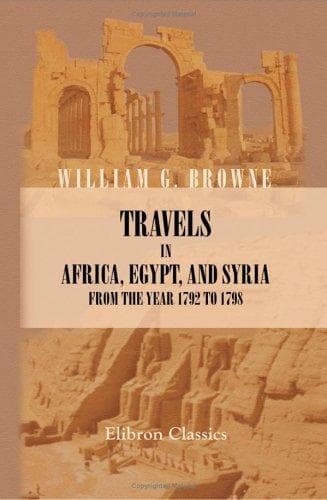
Travels in Africa, Egypt, and Syria, from the year 1792 to 1798Browne, William George
History
Travels in Africa, Egypt, and Syria, from the year 1792 to 1798
Browne, William George
Egypt -- Description and travel; Sudan -- Description and travel; Syria -- Description and travel
Our company consisted of nearly five hundred camels. This exceeds
the number usually employed by the Jelabs on their return from
Egypt, which is often not more than two hundred. In passing from
Dar-Fûr to Egypt, they esteem two thousand camels, and a thousand
head of slaves, a large caravan. Of persons of other countries, but
particularly Egyptians, trading for themselves, there were not more
than fifty, including five or six Coptic Christians, whose admittance
in Dar-Fûr the monarch of that country has since forbidden. Several
of this number were Muggrebines, or Occidental Arabs; the remainder,
amounting to one hundred and fifty or two hundred, including the
chabîr, or leader, were subjects of Fûr. Few particulars of other
caravans are known to me but by report.
The Arabs and Jelabs find the camel too indispensable to their
long and fatiguing voyages, not to employ much care in nourishing
him. This _ship of the land_, (مركب البر,) as he is called, is
exclusively the bearer of their fortunes, and the companion of their
toils. Much care is observed in rearing him, and not unfrequently the
merchant pays nearly as much for the camels to carry his merchandize,
as he did for the commodities themselves; what then must be the
profit that covers his expenses, his fatigue, indemnifies him for
accidental losses, and yet leaves him a gainer? But if this patient
and enduring animal be thus rendered subservient to their wants,
or their avarice, he is not at least tortured for their caprice.
Horses are very little used by the Jelabs. They generally furnish
themselves with Egyptian asses, which alleviate the fatigue
of the way, and are afterwards sold in Soudân at an advanced
price. The strength and spirits of this animal are recruited with
a small quantity of straw and water; the horse has not the same
recommendation; and these people, though not averse from parade in
cities, find the labour and hazard of these voyages too enormous,
not to augment their profits by all possible economy.
The provisions they use are scanty and indifferent, and by no means
testify any foresight for the necessities of the sick, or for the
procrastination of the voyage by those innumerable accidents that
may befal them.
Public-domain text, read in full here on John Shaqi.
Reviews
Reviews
No reviews yet
Be the first to share your thoughts on this work.
Elsewhere in the archive
Join the Discussion
Join the discussion
Sign in to leave a comment or review.
Sign InorCreate an account