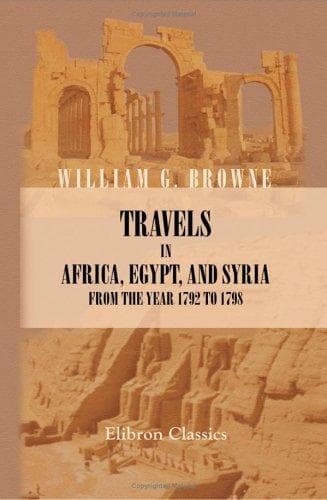
Travels in Africa, Egypt, and Syria, from the year 1792 to 1798Browne, William George
History
Travels in Africa, Egypt, and Syria, from the year 1792 to 1798
Browne, William George
Egypt -- Description and travel; Sudan -- Description and travel; Syria -- Description and travel
The horse is used, but not in great number, nor are the natives very
solicitous as to the breed. The only good horses they possess are
bred in the country of Dongola, and by the Arabs to the East of the
Nile. These are generally larger than we are accustomed to find the
Egyptian horses. They are perfectly well formed, and full of fire,
yet tractable. Their action is grand beyond what I have observed in
any other species; but it is said they are not remarkable for bearing
fatigue. The Arabs, who breed them, are in the habit of feeding them
with milk. They rarely, if ever, castrate them. Horses and mares are
indiscriminately used for the saddle. The horses of Soudân are none
of them shod.
Two or three distinct breeds of sheep, _Ovis aries_, exist in
Soudân, not however very materially differing from each other. The
large-tailed sheep, which are found elsewhere, I believe are here
unknown. The meat is inferior to that of the Egyptian sheep. They
are covered with coarse wool, resembling hair, and apparently
wholly unfit for any manufacture. The goats, _capræ cervicapræ_,
are much more numerous than the sheep, and the flesh of the former
is somewhat cheaper than that of the latter. The goats grow perhaps
rather larger, but otherwise differ not from those of Egypt. It is
not uncommon to castrate both these animals, but neither is it a
very general practice.
The ass here is of the same appearance, and the same indocile nature,
with that of Great Britain. The only good ones are what the Jelabs
bring with them from Egypt: yet the animal is much used for riding;
indeed few persons mount an horse but the military, and those who
are in immediate attendance at court. An Egyptian ass fetches from
the value of one to that of three slaves, according to the weight he
is able to bear. A slave will purchase three or four of the ordinary
breed; yet they are not anxious to improve them. Perhaps the animal
degenerates: but it is certain that his external appearance undergoes
a great change.
Public-domain text, read in full here on John Shaqi.
Reviews
Reviews
No reviews yet
Be the first to share your thoughts on this work.
Elsewhere in the archive
Join the Discussion
Join the discussion
Sign in to leave a comment or review.
Sign InorCreate an account