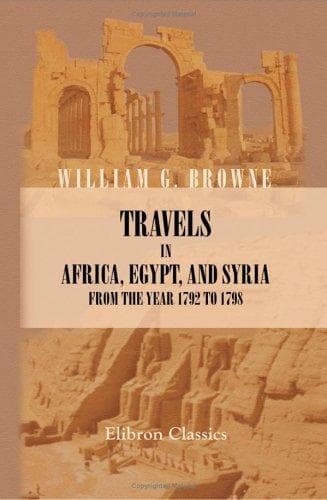
Travels in Africa, Egypt, and Syria, from the year 1792 to 1798Browne, William George
History
Travels in Africa, Egypt, and Syria, from the year 1792 to 1798
Browne, William George
Egypt -- Description and travel; Sudan -- Description and travel; Syria -- Description and travel
Previously to the establishment of Islamism[49] and kingship, the
people of Fûr seem to have formed wandering tribes, in which state
many of the neighbouring nations to this day remain. In their persons
they differ from the negroes of the coast of Guinea. Their hair is
generally short and woolly, though some are seen with it of the length
of eight or ten inches, which they esteem a beauty. Their complexion
is for the most part perfectly black. The Arabs, who are numerous
within the empire, retain their distinction of feature, colour,
and language. They most commonly intermarry with each other. The
slaves, which are brought from the country they call _Fertît_,
(land of idolaters,) perfectly resemble those of Guinea, and their
language is peculiar to themselves.
In most of the towns, except Cobbé, which is the chief residence
of foreign merchants, and even at court, the vernacular idiom is
in more frequent use than the Arabic; yet the latter is pretty
generally understood. The judicial proceedings, which are held in
the monarch’s presence, are conducted in both languages, all that
is spoken in the one being immediately translated into the other by
an interpreter (_Tergimân_).
After those who fill the offices of government, the _Faquî_,
or learned man, i.e. priest, holds the highest rank. Some few of
these _Faquîs_ have been educated at Kahira, but the majority of
them in schools of the country. They are ignorant of every thing
except the Korân. The nation, like most of the North of Africa,
except Egypt, is of the sect of the Imâm Malek, which however
differs not materially from that of Shafei.
_Revenues of Dar-Fûr._
1. On all merchandize imported the king has a duty, which in many
instances amounts to near a tenth; as for instance, on every camel’s
load of cotton goods brought from Egypt, and which commonly consists
of two hundred pieces, the duty paid to the king by the merchants
of Egypt is twenty pieces: the Arabs who are under his government
and the natives pay more; some articles however do not pay so much.
2. In addition to this, when they are about to leave Dar-Fûr on
their return to Egypt, another tax is demanded on the slaves exported,
under pretence of a voluntary douceur, to be exempt from having their
slaves scrutinised. This, on our caravan, which comprised about five
thousand slaves, amounted to 3000 mahbubs, between 6 and 700l. to
be paid to the Chabîr on their arrival in Egypt.
3. All forfeitures for misdemeanors are due to the king; and this
is a considerable article; for in case of a dispute in which blood
is shed, as often happens, he makes a demand of just what proportion
he thinks right of the property of the village in which the offence
was committed, of the whole, of an half, of a third, of every species
of possession, and this most rigorously estimated.
Public-domain text, read in full here on John Shaqi.
Reviews
Reviews
No reviews yet
Be the first to share your thoughts on this work.
Elsewhere in the archive
Join the Discussion
Join the discussion
Sign in to leave a comment or review.
Sign InorCreate an account