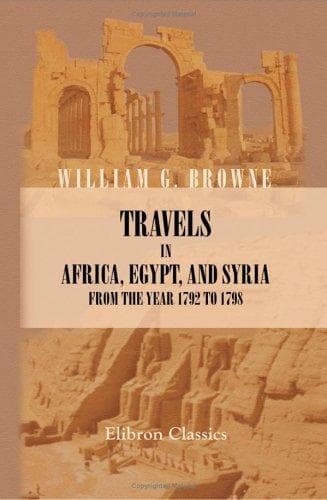
Travels in Africa, Egypt, and Syria, from the year 1792 to 1798Browne, William George
History
Travels in Africa, Egypt, and Syria, from the year 1792 to 1798
Browne, William George
Egypt -- Description and travel; Sudan -- Description and travel; Syria -- Description and travel
8. But one of the most considerable articles of revenue is the tribute
of the Arabs who breed oxen, horses, camels, sheep. Those who breed
horses should bring to the monarch all the males which are yearly
produced by their mares; but this I am told they often contrive
to avoid. The customary tribute of the Arabs who breed oxen, or
_Bukkara_, as they are called, is one tenth[50]. But when I was there,
they having neglected paying it for two years, the Sultan sent a body
of troops, who seized all they could lay hands on, to the number of
twelve thousand oxen. If the tribute were regularly paid, it might
amount to four thousand oxen per annum: but these Arabs live in tents,
and consequently change their habitations frequently, and when they
feel themselves united, are not much inclined to pay tribute. Those
who breed camels should also pay a tenth of their property yearly; and
I have understood that they acquit themselves of the obligation with
more regularity than the former. These also however are sometimes
rebellious, and then nothing is received from them. Two tribes,
_Mahría_ and _Mahmîd_, were at war during my residence in Fûr,
and a battle took place between them, in which many fell on both
sides: the monarch, to punish them for their contumacious behaviour,
sent a Melek with a detachment of about sixty horsemen, who seized
on one half of the camels of every Arab, and where they found five
took three, as the fifth could not be divided. The owners of sheep
and goats pay a tenth.
9. Every village is obliged to pay annually a certain sum in corn,
_Dokn_, which is collected by the king’s slaves. The monarch has
also lands of his own, which are cultivated by his slaves, and which
serve to supply his houshold; for, though a merchant, he does not
sell corn. The whole of the district of Gebel Marra, to the West, is
entirely appropriated to his use, and the wheat, wild honey, &c. which
are abundantly produced there are all reserved for his table.
10. The king is chief merchant in the country, and not only dispatches
with every caravan to Egypt a great quantity of his own merchandise,
but also employs his slaves and dependents to trade with the goods
of Egypt, on his own account, in the countries adjacent to Soudan.
_Articles of Commerce._
Gold rings are sometimes worn in the nose by women of distinction.
Sea-shells (_Cowries_) are among other female ornaments, but not very
current. The red legumen, called _Shûsh_, is much worn in the hair.
Commodities brought by the Jelabs from Egypt are:
1. Amber beads.
2. Tin, in small bars.
3. Coral beads.
4. Cornelian ditto.
5. False Cornelian ditto.
6. Beads of Venice.
7. Agate.
8. Rings, silver and brass, for the ancles and wrists.
9. Carpets, small.
10. Blue cotton cloths of Egyptian fabric.
11. White cotton ditto.
12. Indian muslins and cottons.
13. Blue and white cloths of Egypt called _Melayés_.
Public-domain text, read in full here on John Shaqi.
Reviews
Reviews
No reviews yet
Be the first to share your thoughts on this work.
Elsewhere in the archive
Join the Discussion
Join the discussion
Sign in to leave a comment or review.
Sign InorCreate an account