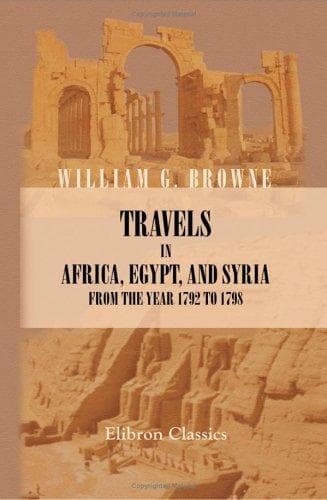
Travels in Africa, Egypt, and Syria, from the year 1792 to 1798Browne, William George
History
Travels in Africa, Egypt, and Syria, from the year 1792 to 1798
Browne, William George
Egypt -- Description and travel; Sudan -- Description and travel; Syria -- Description and travel
It often happens that another operation accompanies that of excision,
which is not, like the latter, practised in Egypt, viz. producing
an artificial impediment to the vagina, with a view to prevent
coition. This happens most frequently in the case of slaves, whose
value would be diminished by impregnation, or even by the necessary
result of coition, though unaccompanied by conception. But it is also
adopted towards girls who are free; the impulse being too strong
to be counteracted by any less firm impediment. This operation,
like the former, is performed at all ages from eight to sixteen,
but commonly from eleven to twelve; nor are they who undergo it
always virgins. In some the parts are more easily formed to cohere
than in others. There are cases in which the barrier becomes so firm,
that the embrace cannot be received but by the previous application
of a sharp instrument[54].
Among some tribes of blacks, there exists a practice of piercing the
skin in certain forms by way of ornament.—Each of the punctures
leaves an indelible scar, as distinctive as colour, which is not
used. This practice, which is of the same description as that of
some of the South-sea islands, is used on the face, breast, loins, &c.
The blacks who are castrated for the use of Kahira or Constantinople,
undergo that operation in the Upper Egypt, before their arrival at
the former; some families, there resident, having the hereditary
exercise of this antient practice.
The numbers which undergo it are not very considerable, and it is
fatal only to a very small proportion of them.
Those slaves which are emasculated for the exclusive use of the
Fûrian monarch suffer within his palace.
CHAP. XXII.
FINAL DEPARTURE FROM KAHIRA, AND JOURNEY TO JERUSALEM.
_Voyage down the Nile to Damiatt — Vegetation — Papyrus —
Commerce — Cruelty of the Mamlûk government — Voyage to Yaffé
— Description of Yaffé — Rama — Jerusalem — Mendicants —
Tombs of the kings — Bethlehem — Agriculture — Naplosa —
Samaria — Mount Tabor._
Having engaged a _canjia_, or small boat, to sail down the Nile from
Kahira to Damiatt, I departed on Friday the 2d of December 1796. No
occurrences worthy of particular commemoration happened during this
little voyage, but we passed several towns of considerable note,
among which may be mentioned Mansûra, remarkable for the defeat
of St. Louis; a circumstance preserved in the name which denotes,
_The place of victory_. Its condition is flourishing, owing to its
being a station on the road between Kahira and Damiatt; and it was
then governed by a Cashef deputed by Ibrahim Bey. The mosques amount
to seven, which is the only circumstance I can offer relative to
its population, my stay there having been only for a few hours.
Public-domain text, read in full here on John Shaqi.
Reviews
Reviews
No reviews yet
Be the first to share your thoughts on this work.
Elsewhere in the archive
Join the Discussion
Join the discussion
Sign in to leave a comment or review.
Sign InorCreate an account