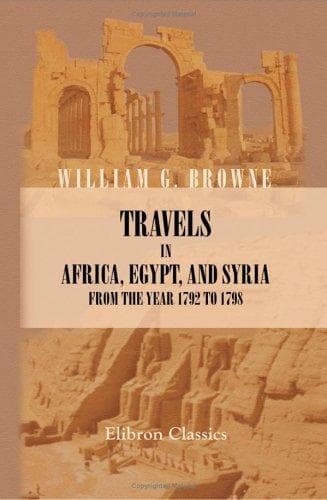
Travels in Africa, Egypt, and Syria, from the year 1792 to 1798Browne, William George
History
Travels in Africa, Egypt, and Syria, from the year 1792 to 1798
Browne, William George
Egypt -- Description and travel; Sudan -- Description and travel; Syria -- Description and travel
On the Saturday following, was the entrance of the Pasha of Damascus,
who is constantly the _Emîr-el-Hadje_, or chief of the caravan by
office. First appeared three hundred dellîs, or cavalry, mounted on
Arabian horses, variously armed and clothed, but on the whole forming
no mean display. These were succeeded by fifteen men on dromedaries,
with musquetoons, or large carbines, placed before them, and turning
on a swivel in every direction. This destructive instrument of war
is said to have passed from the Persians to the Syrians. Some of
the great officers of the city followed, well mounted, and decently
attired. Then came part of the Pasha of Tripoli’s Janizaries, well
clothed and armed; that Pasha himself, with his officers, and the
remainder of his guard. Next was the tattarawân belonging to the
Pasha of Damascus, another body of four hundred dellîs, a company
of thirty musquetooners, a hundred and fifty Albanians, in uniform,
and marching two and two, like our troops. Before the latter was
borne the standard of the Prophet, _Senjiak Sherîfi_, of green silk,
with sentences of the Korân embroidered in gold, and the magnificent
canopy brought from Mecca, guarded by a strong body of Muggrebîns,
or western Arabs, on foot. Then passed the Pasha’s three tails,
(generally of white horses,) borne by three men on horseback; twelve
horses, (a Pasha of two tails has only six,) richly caparisoned,
and each bearing a silver target and a sabre; six led dromedaries,
in beautiful housings; numbers of the chief persons of the city
followed, among whom were the Aga of the Janizaries, the governor
of the castle, and the Mohassel. Last came the Pasha himself, in a
habit of green cloth adorned with fur of the black fox, preceded by
his two sons, the eldest about fourteen, all mounted on the most
spirited steeds of Arabia, and followed by his household troops,
to the number of four hundred, well armed and mounted. More than a
hundred camels had preceded the rest, bearing the tents and baggage
of the Pasha. The whole was conducted without any noise or tumult,
to the great credit of the Damascene mob, who had been waiting
several hours without their usual repast.
Damascus has been often described; but a residence of about two months
may enable me to suggest some particulars worthy of notice. The walls
are of a circular form, suburbs large and irregular. The situation is
in an extensive plain, filled with gardens, to the length of more than
three leagues, and the breadth of more than a league and a half. At
no great distance to the East, rises a ridge of Anti-Libanus. The
river Baradé is above the city divided into many streams, which
are distributed through the gardens; so that there is a supply for
all. The air is excellent, the soil exuberant in fertility. Fruits
more abundant than I have ever seen, particularly the grapes and
apricots, which are of excellent flavour.
Public-domain text, read in full here on John Shaqi.
Reviews
Reviews
No reviews yet
Be the first to share your thoughts on this work.
Elsewhere in the archive
Join the Discussion
Join the discussion
Sign in to leave a comment or review.
Sign InorCreate an account