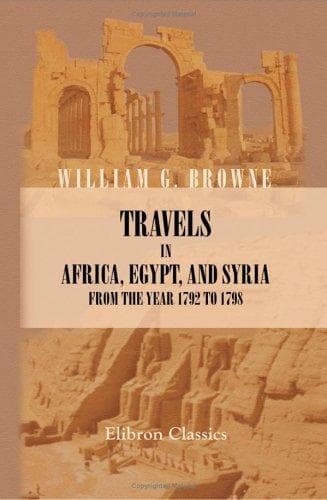
Travels in Africa, Egypt, and Syria, from the year 1792 to 1798Browne, William George
History
Travels in Africa, Egypt, and Syria, from the year 1792 to 1798
Browne, William George
Egypt -- Description and travel; Sudan -- Description and travel; Syria -- Description and travel
A striking contrast exists between the inhabitants of Damascus and
those of Aleppo. The Aleppîns are vain and seditious; the Damascenes,
on the contrary, sober, industrious, and unostentatious. The females
and children have commonly regular features and a fair complexion:
the dress of the women nearly the same as at Constantinople, white
muslin veils, except the prostitutes, who, as usual all over the
East, expose their faces. To paint the face is an improvement unknown
among the Oriental fair, save the Greeks alone.
The charitable establishments in Damascus are numerous, among which
may be noted that constructed by Sultan Selim, for the reception
of strangers; though his munificence have been since diverted into
other channels. The building consists of a vast quadrangle, lined
with a colonade. It is entirely roofed in small domes, covered
with lead. The mosque is grand. The entrance supported by four
large columns of red granite. It is covered with a cupola, and has
two minarets. A handsome garden lies adjacent. The apartments are
numerous, and the kitchen or _mutbach_, on the side opposite to the
mosque, is suited to the grandeur of the establishment.
The celebrated Asad Pasha, mentioned by Niebuhr and Volney, left
an only daughter, of whom, on her marriage with Mohammed Pasha Adm,
sprang the present Pasha Abdallah. Mohammed Pasha Adm was preceded
by Osmân, and succeeded by two of his own brothers successively,
the last of whom, named Derwîsh, was expelled by the intrigues of
Jezzâr, who gained his office, and married the daughter of Mohammed
Pasha Adm. This marriage of ambition, not of affection, terminated
in a divorce a year after. Among other instances his bad treatment
of this lady, it is recorded that Jezzâr, meeting her one day in
the house, where she happened to have _cab-cab_, or Arabian pattens
on her feet, pulled a pistol from his cincture, and fired it at her,
saying, “Art thou the wife of an Arabian peasant? dost thou forget
that thou art the wife of a Pasha?”
Jezzâr retained his ill-won pashalîk of Damascus only a few years;
his government was a continual scene of oppression and cruelty, and he
is supposed to have extorted from the people not less than twenty-five
thousand purses, or about a million and two hundred thousand pounds
sterling; and to have put to death near four hundred individuals,
most of them innocent. His own misconduct and suspicious designs,
when leading the caravan to Mecca, conspired with the machinations
of his enemies at the Porte to deprive him of his office: but
living monuments of his cruelty remain, in the noseless faces and
earless heads of many of the Damascenes. Thus driven from Damascus,
he returned to his former pashalîk of Acré and Seidé, where he
remains. This government, which he held along with that of Damascus,
he has retained upwards of twenty-seven years.
Public-domain text, read in full here on John Shaqi.
Reviews
Reviews
No reviews yet
Be the first to share your thoughts on this work.
Elsewhere in the archive
Join the Discussion
Join the discussion
Sign in to leave a comment or review.
Sign InorCreate an account