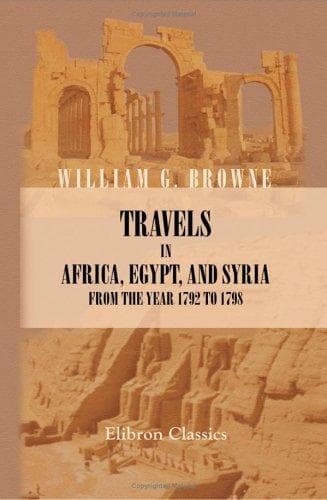
Travels in Africa, Egypt, and Syria, from the year 1792 to 1798Browne, William George
History
Travels in Africa, Egypt, and Syria, from the year 1792 to 1798
Browne, William George
Egypt -- Description and travel; Sudan -- Description and travel; Syria -- Description and travel
The value of land in Egypt is far from being inconsiderable, as is
evident from the large amount of the annual impost which is paid
for it. Yet not having been present at the formalities of bargain
and sale, I feel myself unprepared to give an exact estimate of it.
The same may be said of the value of labour; for as the agricultural
labourer is paid in the produce, a number of circumstances combine to
diminish the value of what is thus received. Comparing the wages of
the husbandman with the price of other labour, I should be inclined
to state them at about six medines, or one-seventh of a piastre per
day, which, as his toil is often remitted, cannot exceed forty-five
piastres annually. Exclusively of the value of the peasant’s
clothing, which lasts long, it is scarcely possible that the maize,
lentils, milk, butter, &c. on which he feeds, can amount to less
than three paras or medines daily, for each individual.
_Tenure of Lands._
An explicit declaration of Mohammed himself, “That property, after
the death of the proprietor, cannot be detained from division among
his heirs,” shews in how great respect inheritance was held by him,
and how little he was inclined to consider as annexed to the sovereign
power, the property of the lands of the countries it governed.
But the same moderation and good policy has not been found among
his successors. His code has been perverted to sanction abuses,
or trampled on by the insolence of power.
In many of the countries over which the Othman emperor exercises or
claims the sovereign authority, the property of the land is claimed by
the Government in right of conquest; and though material exceptions
must have had place in Egypt, with respect to the great number who
embraced Mohammedism, or consented to pay the _Jizié_, and who
consequently did not forfeit their lands, all these distinctions are
now confounded, and, alienations, forfeitures, and, more than all,
violence, have reduced the whole to one undistinguished mass.
The greater part of the lands in Egypt, is to be considered as
divided between the Government, and the religious bodies who perform
the service of the mosques, who have obtained possession of what
they now hold by the munificence of princes and rich men, or by the
measures taken by individuals for the benefit of their posterity. The
property of the mosques is called _wakf_, a term signifying, in its
technical acceptation, the appropriation of a thing in such a way,
that the proprietor’s right in it shall continue, but the profit
belong to some charitable establishment.
Public-domain text, read in full here on John Shaqi.
Reviews
Reviews
No reviews yet
Be the first to share your thoughts on this work.
Join the Discussion
Join the discussion
Sign in to leave a comment or review.
Sign InorCreate an account