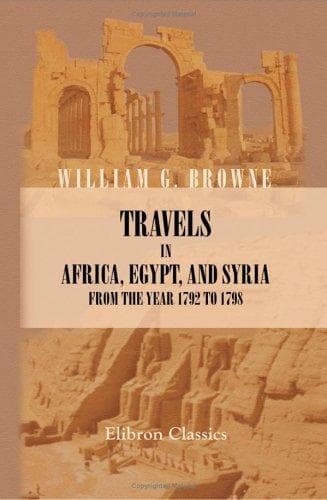
Travels in Africa, Egypt, and Syria, from the year 1792 to 1798Browne, William George
History
Travels in Africa, Egypt, and Syria, from the year 1792 to 1798
Browne, William George
Egypt -- Description and travel; Sudan -- Description and travel; Syria -- Description and travel
The Coptic language may be considered as extinct. Numerous and minute
researches have enabled me to ascertain this fact. In Upper Egypt,
however, they unknowingly retain some Coptic words, such as _Boyúni_,
the name of a month.
Nevertheless, in the Coptic monasteries, the prayers are read in
Arabic, and the epistle and gospel in Coptic; but the priest is a
mere parrot, repeating a dead letter. Coptic manuscripts are found
in some of the convents, and leave to copy them might be obtained
from the Patriarch.
Their creed is the Monothelite, or Eutychian heresy. The solely divine
nature of Christ, the procession of the Holy Ghost from the Father
alone. The Copts embrace transubstantiation; in which, and other
points, the Catholics of Kahira think they approach their faith nearer
than the Greeks. Yet the Copts have adopted from the Mohammedans
the custom of frequent prostrations during divine service, and of
public individual prayer; of ablution after the conjugal rites, &c.
The Copts are an acute and ingenious people. They are generally
writers and accomptants. In business they accumulate money steadily,
without shew; long experience having taught them, what the other
Christians have yet to learn, that, under an arbitrary government,
obscurity is safety. Melancholic in their temperament, but when called
into action, industrious and laborious. Otherwise, fond of their
distilled liquor, and rather licentious in their amours. The Copts
are zealous in their faith, and their ecclesiastics are numerous.
It is remarkable, that in Egypt the children of Europeans seldom
survive their second or third year. This proceeds, it is likely,
from the improper warmth of place and clothing, in which they are
kept by the injudicious fondness of their parents, while the children
of the natives run about almost naked, and enjoy a constitution firm
and vigorous.
CHAP. VI.
KAHIRA.
_Commerce — Manufactures — Mint — Castle and well — Misr
attiké — Antient mosque — Antient Babylon — Fostat — Bulak
— Jizé — Tomb of Shafei — Pleasure-boats — Charmers of
Serpents — Magic — Dancing girls — Coffee-houses — Price of
provisions — Recent history of Egypt — Account of the present
Beys._
Before the revolution in commerce, occasioned by the discovery of the
passage to India by the Cape of Good Hope, that of Kahira was very
extensive. It has since gradually declined, and is now restricted
to the following articles.
From Yemen are imported coffee, odours, gems, and several useful
drugs. From Surat, and other neighbouring parts of India, muslins
and various articles of cotton manufacture, a portion of the spices
of Ceylon; shawls from Cashmîr.
Public-domain text, read in full here on John Shaqi.
Reviews
Reviews
No reviews yet
Be the first to share your thoughts on this work.
Elsewhere in the archive
Join the Discussion
Join the discussion
Sign in to leave a comment or review.
Sign InorCreate an account