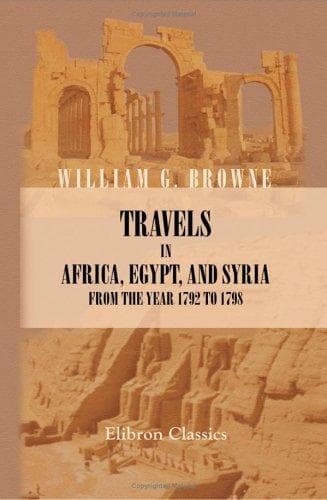
Travels in Africa, Egypt, and Syria, from the year 1792 to 1798Browne, William George
History
Travels in Africa, Egypt, and Syria, from the year 1792 to 1798
Browne, William George
Egypt -- Description and travel; Sudan -- Description and travel; Syria -- Description and travel
Kahira may still be regarded as the metropolis of the trade of
eastern Africa, as Tripoli chiefly possesses that of the west. A
few slaves are brought from Habbesh (Abyssinia) by the way of Jidda
and Mecca. Caravans pass to and from Sennaar, Dar-Fûr, and Fezzan,
bringing slaves, gold-dust, ivory, horns of Rhinoceros, Ostrich
feathers, gum, drugs.
There is another uncertain caravan from Morocco, which employs
five thousand camels for merchandise; part passes to Mecca, and
part remains to transact business, and await the return of the
pilgrims. The other caravans are merely for the carriage of goods;
and the camels are supplied by the Arabs, who rove through the
deserts which form the boundaries of Egypt.
The navigation of the Red Sea cannot be conducted upon worse
principles than it is by the Egyptians and Arabs. The ships are
constructed on a wrong plan, being sharp, while the shallows and rocks
require vessels that draw little water; and they are overcharged with
passengers and goods. Hence the passage would be dangerous, even
if managed by able navigators; but the mariners here are extremely
unskilful, and only pique themselves on avoiding the sunk rocks near
the shore, in which it must be confessed they are very dextrous. The
ships employed by persons residing in Egypt are thirty-seven in
number, so far as I could learn from an agent at Suez, and so many are
lost, that the continual building barely supplies the usual number.
European imports in general have been specified under the head
Alexandria. From Tunis and Tripoli are brought oil, red caps,
of a particular manufacture, for which Tunis is famous, and fine
flannel, used for garments by the Bedouins and others. From Syria
arrive cotton, silk, crude and manufactured, soap, tobacco, beads of
glass. From Constantinople, besides white slaves, male and female,
all kinds of brass, copper, and iron manufactures.
Proceeding to exports, those to Europe have been mentioned in
treating of Alexandria, and those to Dar-Fûr shall be enumerated
when we come to visit that kingdom. To Sennaar and Fezzan, the
same with Dar-Fûr. Hedjas, in Arabia, is wholly supplied with
grain from Egypt, but the trade to India and Jidda is carried on
chiefly by money. To Constantinople, black slaves, chiefly eunuchs,
great quantities of coffee, and some Indian goods, though these be
for the most part conveyed thither by caravans.
Egypt was formerly the granary of Rome and of Constantinople. The
exports of rice remain very great, with considerable quantities of
wheat from Upper Egypt, in favourable years. No oats are seen in
Egypt; and the barley is consumed by the horses.
To Syria are exported rice, crude leather, flax, and sometimes wheat.
Public-domain text, read in full here on John Shaqi.
Reviews
Reviews
No reviews yet
Be the first to share your thoughts on this work.
Elsewhere in the archive
Join the Discussion
Join the discussion
Sign in to leave a comment or review.
Sign InorCreate an account