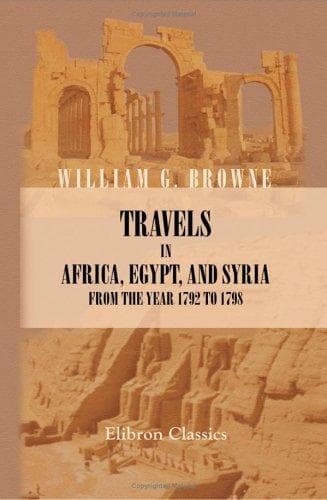
Travels in Africa, Egypt, and Syria, from the year 1792 to 1798Browne, William George
History
Travels in Africa, Egypt, and Syria, from the year 1792 to 1798
Browne, William George
Egypt -- Description and travel; Sudan -- Description and travel; Syria -- Description and travel
Ibrahim Bey, _el Uali_, a name derived from the second military
magistracy in the city, is a young man, about the same age with the
last. He is married, as has been mentioned, to the daughter of the
elder Ibrahim, and is firmly attached to his interests. Of a sedate,
yet firm character. Mamlûks six or seven hundred.
Aiûb Bey, _el zogheir_, or junior, is another powerful leader,
perhaps the most eminent in capacity among the whole, and on
all occasions consulted by the rest. His age, between thirty and
forty. Mamlûks not many. He is a prudent manager, and rarely accused
of extortion.
Fatmé, now the aged daughter of the famous Ali, is held in much
respect by all the Beys. Even Murad, her husband, stands reverently
in her presence. When a Bey is appointed to a government, he never
fails to pay a visit to this old lady, who lectures him on his duties;
and will say, “Do not pillage the people; they were always spared
by my father.”
CHAP. VII.
_Abstract of the history of Africa in general, and Egypt in
particular, under the domination of the Arabs._
As this portion of history is little known, and may lend illustration
to many topics discussed in these pages, I have been induced to insert
a brief idea of it, abstracted chiefly, in what regards Africa,
from the valuable work of Cardonne, a compilation which has saved
me much research into the original writers[16].
Syria and Persia had already fallen under the rapid progress of
the followers of Mohammed, and it was so early as the 19th year
of the Hejira, the 640th of the Christian æra, that the Chalîf
Omar commanded Amrû to subdue Egypt. Memphis, or Misr, submitted
through the treason of the governor; but Alexandria stood a siege of
fourteen months. The loss of the library has been much regretted;
it was probably replete with the absurd philosophy and divinity of
the times; and amid the number of libraries in the Greek empire,
it is impossible to conceive, that the work of any truly valuable
author should have existed only in one copy.
A.D. 643. A famine desolating Arabia, Amrû re-opened the canal,
formed by the Romans from Memphis to the Red Sea. The capital seat
of the Chalîfs being soon after removed from Medina to Damascus,
it was neglected and went to ruin.
A.D. 647. Abd-ullah, governor of Egypt, proceeds to the conquest
of Africa. He vanquishes the Greek patrician Gregory in the battle
of Yakûb.
PART I.
_AFRICA._
Public-domain text, read in full here on John Shaqi.
Reviews
Reviews
No reviews yet
Be the first to share your thoughts on this work.
Elsewhere in the archive
Join the Discussion
Join the discussion
Sign in to leave a comment or review.
Sign InorCreate an account