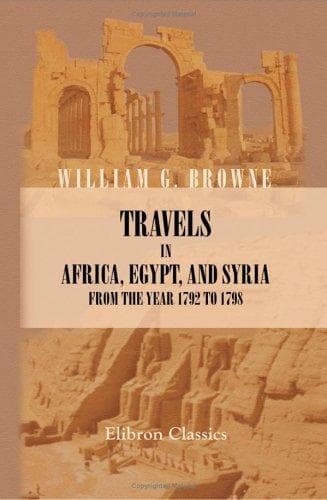
Travels in Africa, Egypt, and Syria, from the year 1792 to 1798Browne, William George
History
Travels in Africa, Egypt, and Syria, from the year 1792 to 1798
Browne, William George
Egypt -- Description and travel; Sudan -- Description and travel; Syria -- Description and travel
1180. Abu-Yakûb carried his arms into Spain, where he received
the homage of several Arabian princes. He was constrained to return
to Africa, on intelligence arriving that a horde of Turks, who had
passed from Egypt, had seized Tripoli, and other places. Sfax had
also revolted. These commotions were appeased; and, at Mehedié,
Abu-Yakûb renewed the truce with Sicily for ten years.
1184. Abu-Yakûb invades Spain, is defeated, and killed. Yakûb his
son succeeded him.
The El-Moravides, who had fled to Spain, endeavoured to regain their
power in Africa. They were supported by the Turks of Tripoli; but
Yakûb took that city, and razed its walls.
1195. Yakûb defeats Alfonso king of Castille at Rema near Cordova,
and besieges Toledo. He makes other campaigns in Spain.
1199. Yakûb dies at Sallî, in his forty-eighth year. The sceptre
passes to Mohammed-el-Nasîr his son.
Mohammed lost all that his ancestors had possessed in Spain.
1210. He attempts to recover his Spanish territories at the head of
600,000 men, according to the wonted exaggerations of the Arabs;
but is completely defeated at the famous battle called _Akal_ by
the Arabs, and _Vanos-Tolosa_ by the Spaniards. Mohammed died of
vexation the following year. The Elmohâds had possessed Valencia,
Seville, Carmona, &c.
1211. Yussuf, son of Mohammed, proved a voluptuous and feeble
prince. He reigned twelve years, and died without posterity.
1223. Abd-el-wahhad, his great uncle, succeeded, or was chosen by the
grandees. The same year the royal title was transferred to Abd-ullah
his nephew, who was murdered by rebels.
1226. Edrîs-ben-Yakûb, brother of Abd-ullah, became king of Africa,
and used great cruelties to establish his authority. After reigning
five years, he died of an apoplexy.
1231. His son Abd-el-wahhad succeeded, and was drowned when
bathing. Other princes of this dynasty were, Said-Abul, 1242; Umer,
1248; Wasîk-Abul, 1266. In this usurper closed the dynasty of
the Elmohâds.
* * * * *
Upon the fall of this powerful dynasty, Africa was divided into
those petty royalties which still subsist, with few variations.
The family of the _Merinis_ became masters of Fez and Morocco,
and were the most powerful of the successors of the Elmohâds.
The Abi-Hafs seized Tunis; and the Beni Ziân enjoyed Tremesen.
Abu-’l-Hassan, sultan of Morocco, became sovereign by conquest,
about A.D. 1347, of all the African states; but this power was only
a momentary meteor.
About the year 1500 an ambitious _Sherîf_, or descendant of Mohammed,
seized the sovereignty of Morocco; and his descendants, under the
style of Sherîfs, retain the power to this day.
The kingdom of Tremesen, on the East of Fez, contained Algier, Oran,
&c. It was seized by the Beni Ziân about A.D. 1249. On the death
of the last of that race, A.D. 1560, it was united to the Turkish
Deydom of Algier.
Public-domain text, read in full here on John Shaqi.
Reviews
Reviews
No reviews yet
Be the first to share your thoughts on this work.
Elsewhere in the archive
Join the Discussion
Join the discussion
Sign in to leave a comment or review.
Sign InorCreate an account