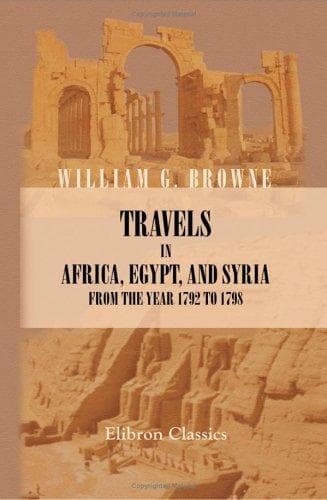
Travels in Africa, Egypt, and Syria, from the year 1792 to 1798Browne, William George
History
Travels in Africa, Egypt, and Syria, from the year 1792 to 1798
Browne, William George
Egypt -- Description and travel; Sudan -- Description and travel; Syria -- Description and travel
I landed near Assiût, and went to an okal in that city to lodge. Here
I suffered no kind of inconvenience.—A small room, dry and perfectly
quiet, not infested with vermin, answered the purpose of security
to property; and in this climate, at such a season, no shelter is
required except from the sun’s rays. Assiût is, at this time, by
far the most considerable city in the higher Egypt. This character
formerly belonged to Girgi, which is in effect still a place of
note, but less so than Assiût. The situation is in all respects
favourable, and the manner in which the water is conducted round the
town is worthy of remark. A canal, dug probably from an early period,
parallel to the Nile, in this part of the country laves the foot of
the mountains which are near to Assiût, and having surrounded that
city, and the villages adjacent, descends again into the river. The
water, however, is not admitted into it but at a certain period
of its increase, and then it overflows all the surrounding lands,
and Assiût only communicates with the Nile, by a road, artificially
raised above the common level, which leads down to the point where
the boats resort, and are laden and discharged; and by two bridges,
the one leading to this road, and the other towards the mountains.
It has become much more populous within a few years by the good
government of Solyman Bey, who has also adorned it by planting many
trees. Assiût was formerly known to the Arabic writers by the name
of _hâut-es-Sultân_, the king’s fish, or fish-pond, for حوض
signifies both. It would be curious to inquire from what circumstance;
whether from having been appointed to supply the king’s table
with fish, or what other reason? The mountains above Assiût abound
with caverns which have probably originally answered the purpose of
sepulture, and then, in the Christian age, may have been the resort of
persons who sought religious retirement. There are some hieroglyphic
inscriptions, but nothing very remarkable, and they have been already
described by former travellers, so that it is not necessary to give
a detailed account of them here. The principal antiquities between
Kahira and Assiût, are at Shech Abade[21], the antient Antinoopolis,
and at Ashmunein. In the former are two Corinthian columns, highly
adorned, standing diagonally opposed to each other, and having each
a Greek inscription. The first words of the one are as follow,
ΑΓΑΘΗ ΤΥΧΗ
ΑΥΤΟΚΡΑΤΟΡΙ ΚΑΙΣΑΡΙ ΜΑΡΚΩ ΑΥΡΗΛΙΩ.
The next word appears to be ΣΕΚΟΥΝΔΩ, but it is obliterated[22].
Public-domain text, read in full here on John Shaqi.
Reviews
Reviews
No reviews yet
Be the first to share your thoughts on this work.
Elsewhere in the archive
Join the Discussion
Join the discussion
Sign in to leave a comment or review.
Sign InorCreate an account