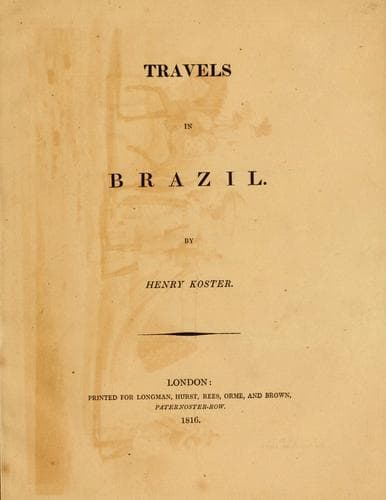
Brazil -- Description and travel; Slavery -- Brazil
Our journey took us again through the village of Mamanguape; and a
little distance beyond it, I left the road, accompanied by the guide,
and went to the principal house of a sugar plantation, where we asked
for a night’s lodging. I was told that the master was not at home,
and great doubts seemed to be entertained of taking us in. Whilst we
were talking at the door, a young man of dark colour came up, mounted
a horse which was standing there without a saddle, and rode off,
seemingly avoiding to observe that there were any strangers present.
One of the black women said, “Why did not you speak to him, for he is
one of our young masters.” I now enquired and discovered that the owner
of the place and his family were mulattos. This was the only instance
of incivility I met with, and the only occasion on which a night’s
lodging was denied to me during the whole course of my stay in Brazil.
We lodged this night under a tree, distant about one hundred yards from
the _engenho_, near to a neat and comfortable looking cottage, of which
the owner was an elderly woman; she was civil to us, and expressed her
sorrow at the treatment which we had received. There had been very
little rain here, for the grass in the field of the plantation had
still a parched look, and the cattle were in bad condition.
Towards the evening of the following day we reached a hamlet, and at
one of the cottages I obtained permission to pass the night. There was
a pent-house standing out from the front; these are usual even for
dwellings of wealthy persons. Under it I slung my hammock, but was
surprised to find, that though the house was inhabited, still the door
was shut, and that the person within spoke to us, but did not open it.
This I thought strange, and began to suppose that he might be afflicted
with some contagious disorder and had been forsaken by his friends, or
rather, that his family had been advised to remove to some neighbouring
cottage. But the guide explained, saying that the man had been bitten
by a snake, and that the bite of this species only became fatal if
the man who had received it saw any female animal, and particularly
a woman, for thirty days after the misfortune. As the lower orders
imagine that all snakes are poisonous, it is not surprising that many
remedies or charms should be quoted as efficacious. It is well known
that many of those reptiles are innoxious, but as this is not believed
by the people in general, it is naturally to be supposed that any cause
rather than the true one is ascribed on a recovery from a bite.
Public-domain text, read in full here on John Shaqi.
Reviews
Reviews
No reviews yet
Be the first to share your thoughts on this work.
Elsewhere in the archive
Join the Discussion
Join the discussion
Sign in to leave a comment or review.
Sign InorCreate an account