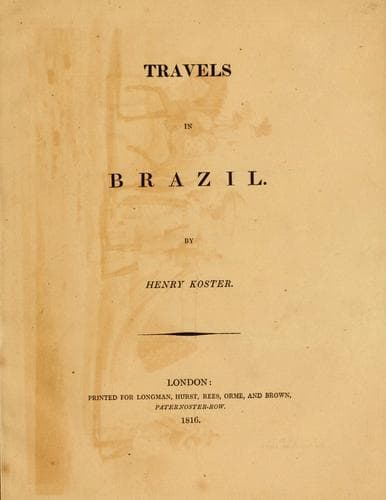
Brazil -- Description and travel; Slavery -- Brazil
VOYAGE FROM PERNAMBUCO TO MARANHAM.—ST. LUIZ.—TRADE.—WILD
INDIANS.—THE GOVERNOR.—ALCANTARA.—THE AUTHOR SAILS FROM ST. LUIZ,
AND ARRIVES IN ENGLAND.
EIGHT days after my return from Searà, arrived a vessel from England,
bringing letters which obliged me to leave Pernambuco and proceed
to Maranham. As a cargo could not be obtained for the brig at the
former place, the consignee determined to send her to Maranham, and
being myself desirous of taking advantage of the first opportunity, I
prepared for the voyage, and sailed in the course of forty-eight hours.
We weighed anchor on the 25th February, and had a prosperous passage
of seven days. We were in sight of the land nearly the whole time, and
occasionally, as the brig was small, and the master wished if possible
to become acquainted with the points of land, we were very near to it.
The Portugueze ships seldom come up this coast without a pilot, nor is
it prudent to do otherwise; but we could not obtain one without delay,
to which the master objected. He had scarcely ever before been out of
the British seas; but their school is good, and now he found his way
to Maranham with as much dexterity as an experienced pilot. This coast
is generally known to be dangerous; and the land has for the most part
a dreary and dismal look, particularly after passing Rio Grande. We
entered the bay of St. Marcos with the lead going, took the channel to
the eastward of the _baixo do meio_ or middle bank, passed the Fort of
St. Marcos, and came to an anchor opposite and very near to the sand
banks at the mouth of the harbour of St. Luiz. As no pilot came off to
us, the master and myself got into the boat, intending to fetch one;
but on coming opposite to the Fort of St. Francisco, a gun without shot
was fired, and the sentinel beckoned us back to the ship. We pulled for
the fort, and when we approached it, an enormous speaking trumpet was
produced, and through it we received orders not to proceed to the city.
However we landed at the fort, and I told the officer that the master
was particularly desirous of having a pilot, as he was unacquainted
with the bay or port; but it is well known that they contain many sand
banks. We were answered that the pilot would come in due time; and
finding remonstrance of no avail, returned to the ship. When the pilot
arrived, he was accompanied by a soldier and a custom-house officer. It
was with some difficulty that I could persuade the master to allow the
former to come into the vessel. Sailors and soldiers never very well
agree, and the blunt Englishman said that he had no idea of his ship
being taken from him by a fellow in a party-coloured jacket. This was a
new regulation. Indeed in most of those regarding the port of Maranham,
I could not avoid recollecting the old proverb of “much cry, &c.” As
the brig came up the harbour, we received the health and custom-house
visit. It was composed of several well-dressed men, some of whom wore
Public-domain text, read in full here on John Shaqi.
Reviews
Reviews
No reviews yet
Be the first to share your thoughts on this work.
Elsewhere in the archive
Join the Discussion
Join the discussion
Sign in to leave a comment or review.
Sign InorCreate an account