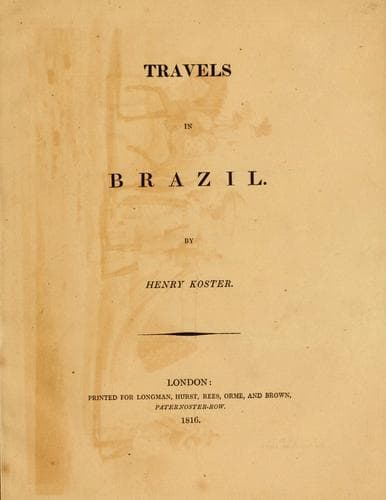
Brazil -- Description and travel; Slavery -- Brazil
Itamaraca is one of the oldest settlements of the Portugueze upon
the coast of Brazil. It was given to Pero Lopes de Souza, who took
possession of it in 1531.[101] The Dutch made an attack upon it in
1630, and although they did not succeed in taking Conception, they
built a fort which they called Fort Orange[102], and this is the
fortress which now exists upon the island. However, in 1633, the Dutch
“dispatched such a force as rendered resistance hopeless; the town of
Conception was yielded to them, and with it the whole island[103].” In
1637, the Dutch deliberated, “whether the seat of government should
be removed to the island[104].” This did not take place; the opinion
of those who proposed the plan being over-ruled, but I cannot avoid
thinking that it possesses many advantages of which Recife cannot
boast. The port of Itamaraca may not admit of vessels of so much
burthen as the Poço harbour of Recife, but the former is much more safe
even than the Mosqueiro port. If Brazil was to be at war with any naval
power, Recife might be destroyed with ease, whereas if a town had been
erected upon the main land, opposite to the island, or upon the inside
of the island, it could not be molested by shipping, for it would be
necessary that a vessel should enter the channel before she could
bring her guns to bear. Besides this advantage, Itamaraca and the
neighbouring shores of the main land, enjoy those of wood and water in
abundance, in the latter of which Recife is particularly deficient. In
1645, Joam Fernandes Vieira, the principal hero of the Pernambucan war,
attacked the island, but did not succeed in dislodging the Dutch[105].
The Portugueze again attempted to regain possession of it in 1646; they
crossed over at a place called Os Marcos[106], which is now a coco-tree
plantation, and a large house is built upon it; the property belongs to
a Portugueze cattle-dealer who resides chiefly at Iguaraçu. Opposite
to Os Marcos is the shallowest part of the channel. The Portugueze did
not gain their point entirely, “but the Dutch abandoned all their other
posts to retire into the fort”[107], which was not surrendered to the
Portugueze until the expulsion of the Dutch in 1654.[108]
Public-domain text, read in full here on John Shaqi.
Reviews
Reviews
No reviews yet
Be the first to share your thoughts on this work.
Elsewhere in the archive
Join the Discussion
Join the discussion
Sign in to leave a comment or review.
Sign InorCreate an account