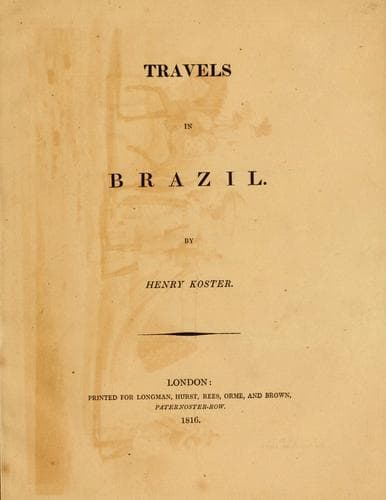
Brazil -- Description and travel; Slavery -- Brazil
I had a visit in October from a strange old man, whose age was
generally supposed to border upon ninety years. He was a creole black,
and had been a slave upon the plantation of Santos Cosmo e Damiam in
the Varzea to the southward of Recife; he had settled at Iguaraçu,
after he obtained his manumission, having married when he was about
seventy years of age, a young woman of his own colour; and he was now
surrounded by a young family. This man did not reckon his age by
years, but by the governors; and as each of these, with few exceptions,
remained at the head of the province only three years, something near
the truth could be collected. This mode of computation is very common.
I have often, on asking the age of any person, received for answer,
that the individual concerning whom the enquiry was made, had been born
in the first, second, or third year of such a governor. The dreadful
famine of 1793 is also an era from which the peasants date many
circumstances.
Old Apollinario was staying at Conception with a friend, and I
requested him to come down to my place every evening for the purpose
of teaching some of the young persons their prayers, a task of which I
knew him to be fond, as he considered this to be a meritorious action;
one by which he would have still further services to plead in his
favour with the Virgin and St. Peter, as he himself told me. When he
came to give his report to me of the progress of each negro, I liked
much to keep him, that I might converse with him. He often spoke of the
Jesuits, under the name of the _Padres da Companhia_; he was fond of
them, but he added, “I must not speak well of them, for our prince does
not like them; and yet they did a great deal of good too.” He said that
they were true and saint-like _padres_, very different to those of the
present day. He was much surprised at my knowing any thing about them;
he said, “You were not alive at the time they were here, and even if
you had been alive, you could not have been in Pernambuco; therefore
how is it that you know of their existence at the time of which I
speak.” I never could make him perfectly comprehend how I obtained my
knowledge of them. But he was not the only person whose comprehension,
thus taken by surprise, could not contain the new ideas which were
imparted, by the knowledge of the existence of books spread all over
the world, and of men who wrote for the instruction of others. Some
of these people with whom I conversed were much puzzled, when I spoke
of the variety of languages and countries in the world; “then,” they
would say, “how is it that people understand each other?” To this I
answered, that these languages were to be acquired by study. “Yes, I
understand you,” they would rejoin “you are all much cleverer than we
are here[137]; we could not learn any language but our own.” These
people were invariably humble, and always ready to receive instruction.
Public-domain text, read in full here on John Shaqi.
Reviews
Reviews
No reviews yet
Be the first to share your thoughts on this work.
Elsewhere in the archive
Join the Discussion
Join the discussion
Sign in to leave a comment or review.
Sign InorCreate an account