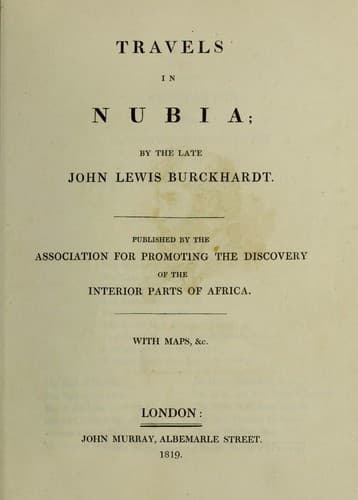
Burckhardt, John Lewis, 1784-1817; Nile River Valley -- Description and travel; Nubia -- Description and travel
In two hours and a half from Ebar the road takes a S. W. direction,
and continues close to the river, opposite Say; a thick grove
of palm trees lining the shore. In three hours we came to Koeyk
(قويق): the plain is here covered with the tombs of Nubian
saints. Four hours, Wady der Hamyde, opposite to which is the
southern extremity of the island of Say. The Wady Hamyde has a king,
or Melek, of the Arab tribe of Hamyde,[36] who is tributary to the
governors of Nubia. On the east side of the river is a large pier
or jetty, formed of huge sand-stones confusedly thrown in upon each
other. On both sides are numerous habitations, and thick groves
of date-trees; indeed Wady Hamyde seemed to be more populous than
any part of the country south of Ibrim. The dates of Sukkot and
Say are preferred to those of Ibrim, and are considered superior
to all that grow on the banks of the Nile, from Sennaar down to
Alexandria: they are of the largest kind, generally three inches
in length. As there is no navigation northwards through the Batn
el Hadjar, these dates reach the northern parts of Nubia only in
small quantities, as presents. They are sold to the Arabs Sheygya,
who arrive here in large caravans, and take them in exchange for
Dhourra (one measure of Dhourra for an equal measure of dates),
for butter, and for targets made of the skin of the hippopotamus,
which are highly prized by the Nubians; there are few date trees
in the country of the Sheygya, and those of a bad kind. Five hours
brought us to Wady Aboudy (وادي عبودي), opposite to which,
in the eastern plain, is a high insulated hill. Here the river
takes a direction S. S. E. The sandy and quartzy plain continues,
and the eastern mountain is from twelve to fifteen miles distant
from the river. Six hours, Irau (اِرَو); here many of the
houses are abandoned, and there is very little cultivation. This
is the southern limit of the district of Say, which name, though
properly confined to the island only, is commonly applied to the
whole country between Sukkot and Mahass. From hence, southwards,
begins the Dar el Mahass. Our route now lay S. 1 W. To the west,
the low hills again begin to form a chain, which increases in
height towards the south. In seven hours we reached Eshamotto
(اشامطّو). Eight hours and a half, El Waouy (الواوي),
a considerable village. The river here takes a circuitous bend to
the westward. We made a short cut across the plain, and at the end
of nine hours and a half, halted for the night at a few huts of
Kerrarish Arabs. I put our hosts into good humour by distributing
some Dhourra amongst them; to testify their gratitude, two of
them kneeled down by my side, and began rubbing and _kneading_
my body, legs, and arms, in the same manner as is done in the
Turkish baths. After a fatiguing journey, the limbs are benumbed;
this operation restores the circulation of the blood, and induces
a gentle slumber.
Public-domain text, read in full here on John Shaqi.
Reviews
Reviews
No reviews yet
Be the first to share your thoughts on this work.
Elsewhere in the archive
Join the Discussion
Join the discussion
Sign in to leave a comment or review.
Sign InorCreate an account