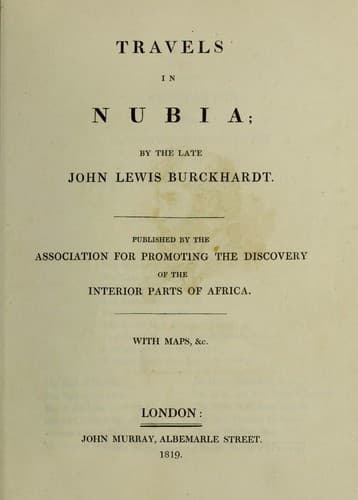
Burckhardt, John Lewis, 1784-1817; Nile River Valley -- Description and travel; Nubia -- Description and travel
The two brothers, the Kashefs Hosseyn and Mohammed, had come to
Mahass, in order to besiege the castle of Tinareh, which had been
seized by a rebel cousin of the king of Mahass. The latter being
Hosseyn Kashef’s father-in-law, the Kashef was bound to come
to his aid, and had accordingly brought with him about sixty men,
with whom I found him encamped, or rather hutted, on the western
side of the river, close under the walls of the castle, while his
brother Mohammed had possession of the eastern bank, with an equal
number of men. They had been here for several weeks, and had often
summoned the castle, to no purpose, although the garrison consisted
only of fifteen men. They at length conceived the idea of cutting
off the water from the besieged, by placing close in shore, just
below the castle, a vessel, which they had sent for from Argo, and
on board of which they put some men armed with musquets, who were
protected from the fire of the garrison by a thick awning formed
of the trunks of date trees thrown across the deck; these men, by
their fire, having effectually prevented the besieged from obtaining
water from the river, the garrison was under the necessity of making
proposals for peace; pardon, and safe conduct, were promised them,
and the castle was surrendered on the evening preceding my arrival.
When I reached the camp of Mohammed Kashef, he was not present, but
occupied, with his brother, in taking possession of the castle. His
people crowded round me and my guide, desirous to know what business
had brought me among them, and supposing that I belonged to the
suite of the two Mamelouk Begs, of whose arrival at Derr they had
already been apprized. Shortly afterwards, Mohammed came over from
the opposite bank with his suite, and I immediately went to salute
him. Born of a Darfour slave, his features resembled those of the
inhabitants of Soudan, but without anything of that mildness which
generally characterizes the Negro countenance. On the contrary,
his physiognomy indicated the worst disposition; he rolled his eyes
at me like a mad-man; and, having drank copiously of palm-wine at
the castle, he was so intoxicated, that he could hardly keep on
his legs. All his people now assembled in and around his open hut;
the vanquished rebels likewise came, and two large goat skins of
palm wine were brought in, which was served out to the company
in small cups neatly made of calabashes; a few only spoke Arabic;
the Kashef himself could scarcely make himself understood; but I
clearly found that I was the topic of conversation. The Kashef,
almost in a state of insensibility, had not yet asked me who I was,
or what I came for. In the course of half an hour, the whole camp
was drunk; musquets were then brought in, and a feu-de-joie fired,
with ball, in the hut where we were sitting. I must confess, that at
this moment I repented of having come to the camp, as a gun might
have been easily levelled at me, or a random ball have fallen
to my lot.
Public-domain text, read in full here on John Shaqi.
Reviews
Reviews
No reviews yet
Be the first to share your thoughts on this work.
Elsewhere in the archive
Join the Discussion
Join the discussion
Sign in to leave a comment or review.
Sign InorCreate an account